
Day 39: May 11, 2026
Will crossed a major ecological threshold, entering the “land of little sticks” and pushing to advance while the rising tide of brown slush signals the imminent end of river surface travel.
-
It's Will here. May 11th, day 39 on the Horton River. Did a real long day today. I did 11 hours. Got up at 4, out at 5. And it was a beautiful morning to start with. The sun was out. And a little bit of a north wind, kind of a cool wind, pleasant. I was hoping the coolness of the north wind would keep the clouds down. But what happens here, each time you get what looks like a sunny day, the energy from the sun, the warmth hits the cold of the ice and you get these clouds that come rolling in. The sun really tried hard. It looked like between that and the north wind blowing and clearing it, it looked like it might have a day of intense sun, but it didn't work out that way. It kind of gave in to the clouds about 2 o'clock, which was fine. And it wasn't a real hot day at all, but it was very comfortable.
The river now is definitely a regular river. I've been in the headwaters area and the large marsh area the last 10 days, and now it's gaining at least width. And it's got banks and topography on either side. So it's just a stunning little water. It doesn't have any water in it yet other than slush, which I'll talk about later.
But I am entering, though, the land of the little sticks. This is an area, my favorite biome of all. It's that area between the forest and the barren areas. You get these shrunken, small little trees. They're all spruces, and some of them are alone and some of them are in clumps, and they all have their individual personality because they withstand, you know, the really tough depth, the real tough weather up here. And they hang together in clumps, too, like a little family. They protect each other. And within the clumps, too, that provides nesting and wildlife, and the ptarmigan usually hang out there.
But as I travel today, I made about 15 miles. And I've been traveling more west and now south a little bit, dips down south. The trees got more numerous. They're small and skinny. Numerous meaning, you know, maybe a tree every 40 feet. They look like almost little blades of grass. If you're on the Internet, on the satellite photo, which I would encourage you to look at it, it's [... ... ...], there's some real interesting stuff coming up. But you can actually see these individual trees on the satellite. I studied this area and exactly how I saw it on the satellite—it looks that way here on these ridges.
And also, it gives me security. It always has, you know, you have trees. We have shelter, of course, from the winds, and then especially firewood if you get it. But so ... And then my goal here is ... I'm not sure why I'm pushing so hard. I think my days are numbered on the river. There hasn't been any really major warm spell at all. There's enough, so if there's slush is starting, that's real present today. And once that slush gets deeper, you get to a point where you can't travel or you can't cross from one bank to another. And so I saw a radical change on the slush starting to appear. And then later in the day, this brown slush, it's water from the land that's starting to come in. And that usually spells the end of it. It doesn't mean the breakup, but it means the travel, this dry river bed as it is now, starts filling in certain areas and that.
And there's not too much of a danger yet. I think I've got a day or two that I can stretch it out. And what I'm trying to do is get further along maybe another 20 miles because this land of the little sticks grows thicker. And they're actually forested in some of the valleys coming up. Nothing like you would see in Minnesota, but still trees and protection like that.
But I'm traveling hard now to get down there so I can get some ... to wait it out in the forest a little bit, at least enough for wood, so I can cook with wood rather than the gas and that. And just I'm a lot more comfortable. But I do think I'll have a couple more days left maybe if I get by today, tomorrow. The crust really held today. It was a really good frost again. You know, that's one advantage of this colder spring up here is it does freeze. So you get a good crust. And I was able to walk on that crust for about eight hours. And then I switched over. It's hard to ski in the morning because it's too slippery. But then once it starts thawing a little bit, I get better grips on the skis. And I was pretty much on my feet as I have been the last 10, 12 days without using skis. But I was on skis in the last three, four hours. And I was able to actually cross a lot of this slush. It's not deep underneath. But if you're walking, you know, you get ankle deep and so forth. But it's changing fast. But I think tomorrow I'll be able to get a day in in skiing, to ski over the crust of this. But within a couple of days, it gets deeper and I wouldn't be pushing it right now. It's pretty safe other than this brown slush that's coming in. That's game over. And once that starts flowing, there's no stopping it. You know, this other slush usually slows down in the evening.
But any rate, I'm pretty tired out and feeling really pretty good, though, about everything. And I think I've got a couple more days. And I probably will start tomorrow about 5 instead of 4 and push the afternoon a little bit more with skis on. And so that's it for day 39. It was really just a fascinating day. A lot of changes around every bend, you know, the different types of slush. Lots of changes to watch. That's really what I like to do. And then some challenging stuff, too. Because I can read the slush, I can read the water under the ice by certain ... you know, I can talk about that later, how you do that. But it's interesting. It keeps you on your toes. And it was really nice. It's been much better than, you know, hauling in the deep snow and doing relays. And this is Will, 39 days in, and May 11th, and over and out.
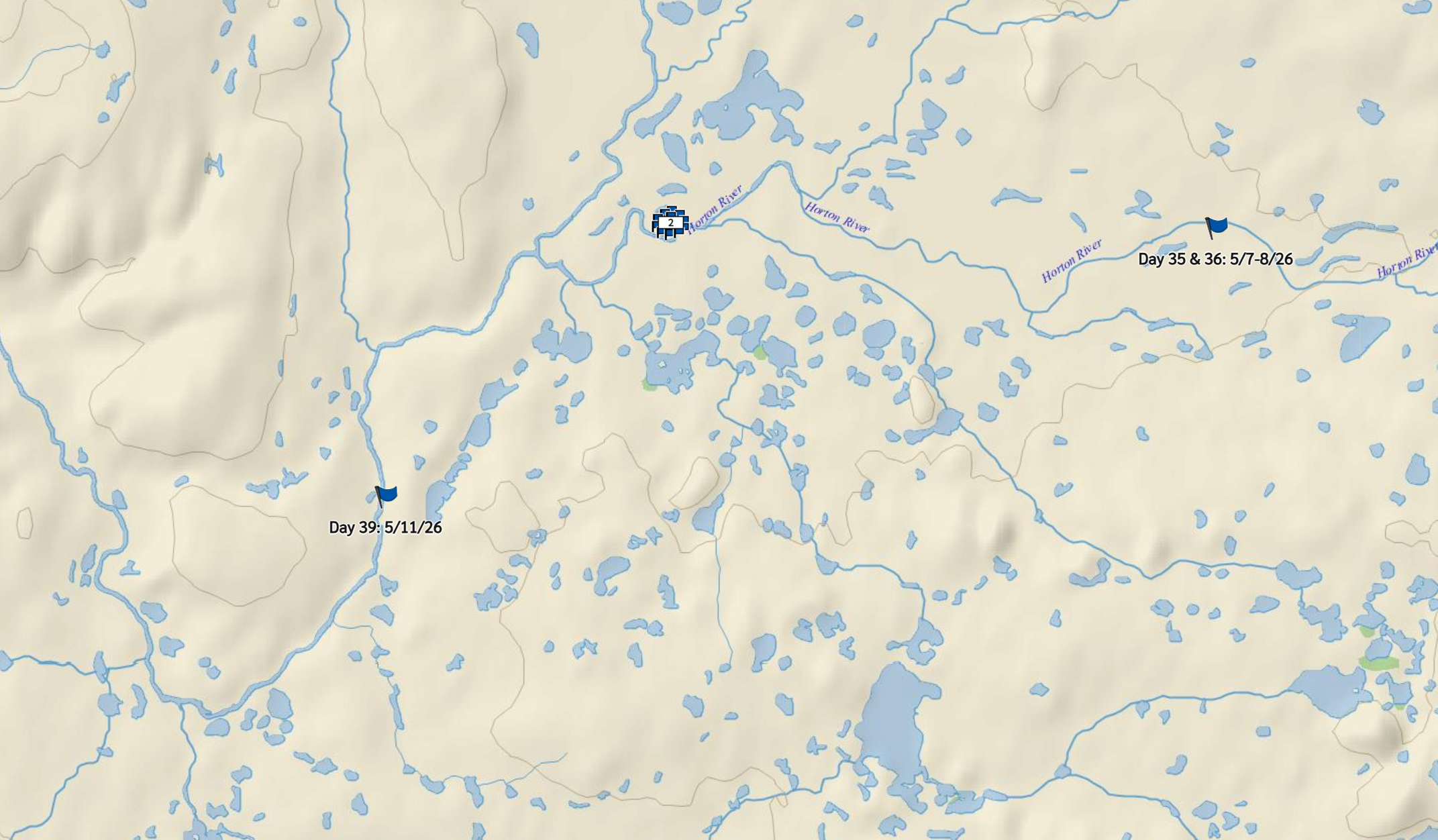
The Horton dips south and Will is pushing to advance out of the slushy wetlands before the river breaks up. Visit Will’s interactive map for complete control of magnification and orientation.
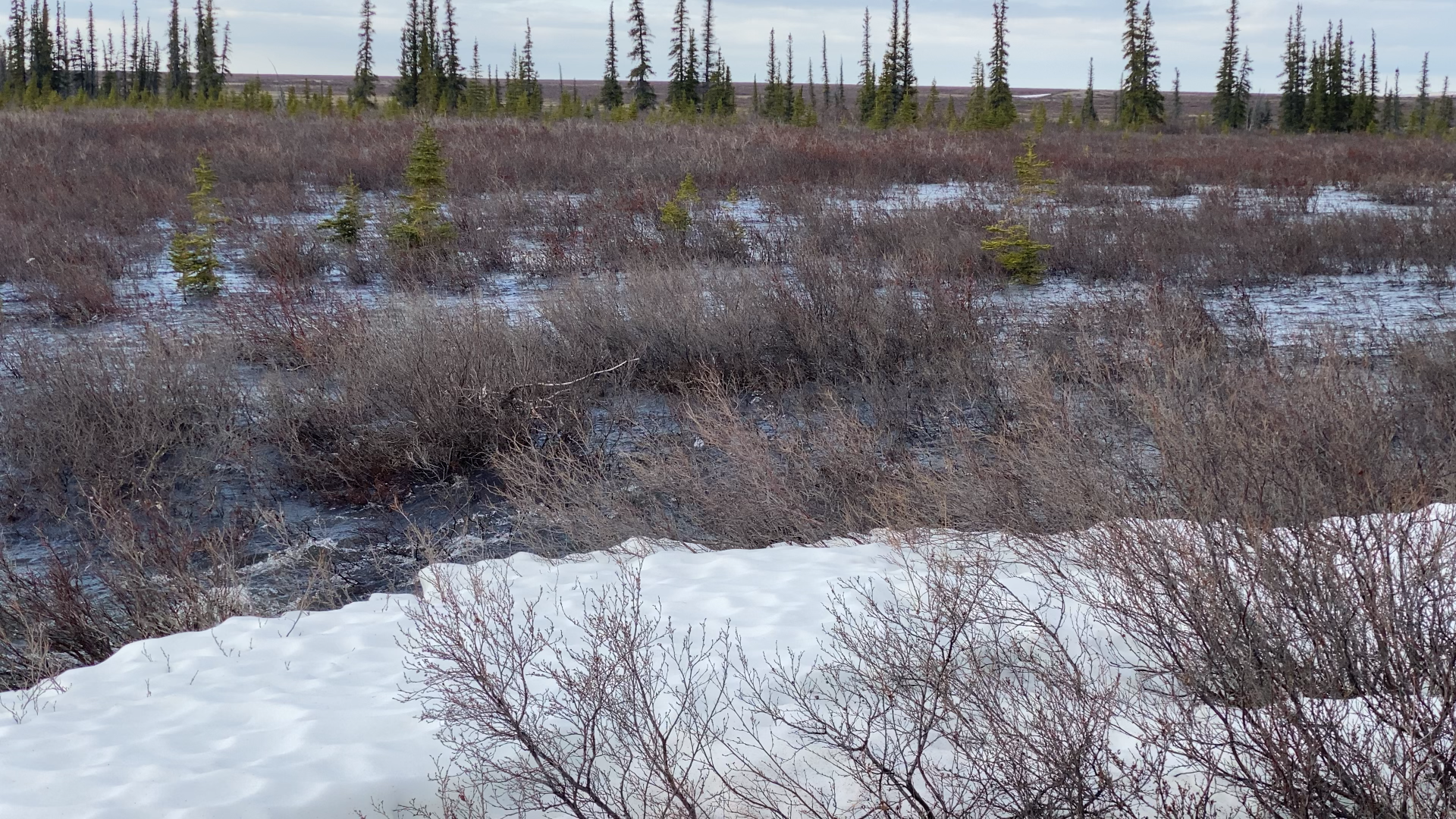
The “land of the little sticks,” as dubbed in today’s dispatch, features a landscape sparsely covered by spruces growing solitary or in clumps, providing shelter for ptarmigans and other wildlife and wood for cooking and heating. This frame comes from Will’s 2023 solo expedition.
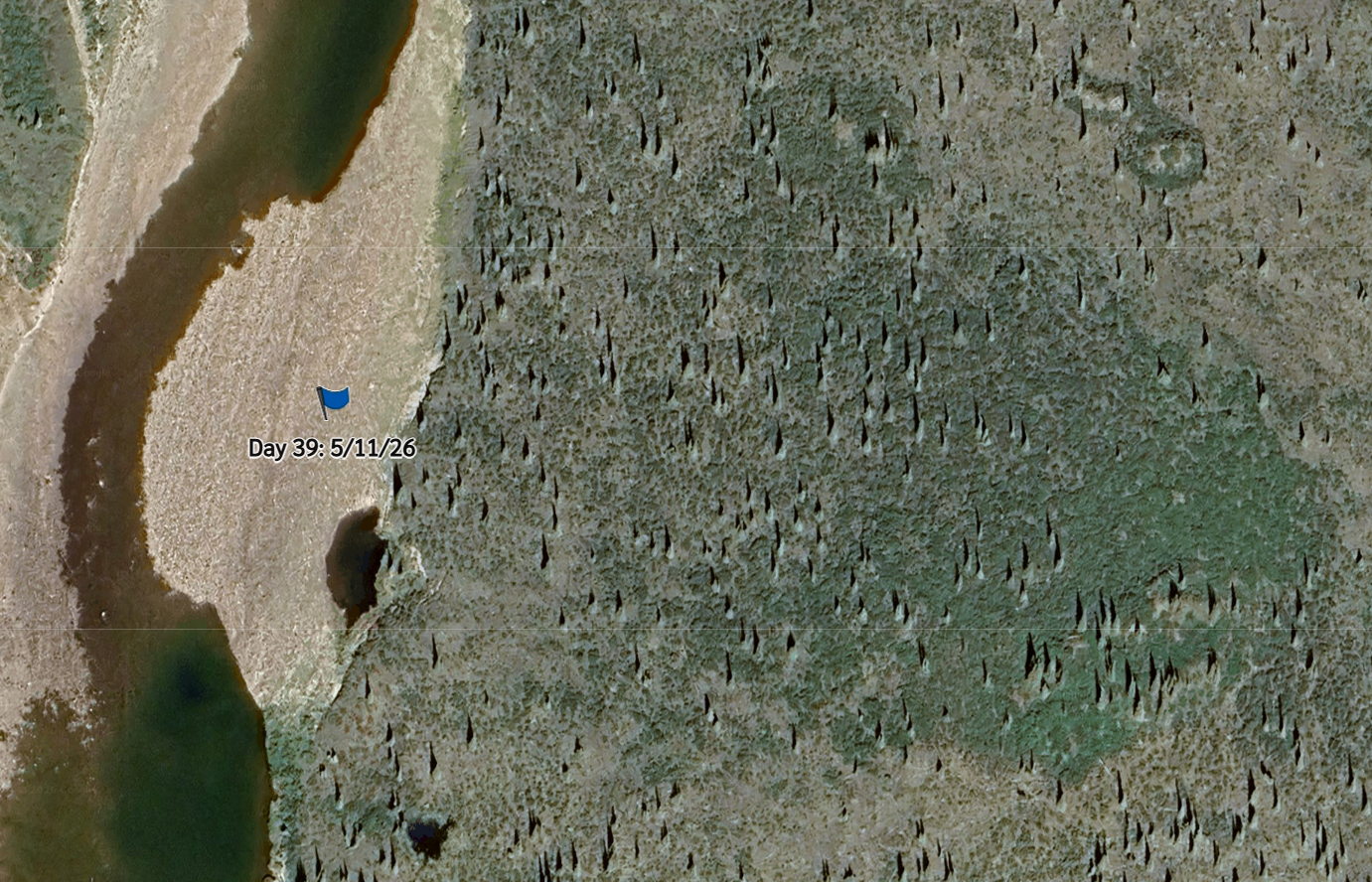
In the dispatch, Will recommends zooming in on his interactive map because the biome he describes, seen here, is clearly visualized.