
Day 38: May 10, 2026
Warmer temperatures make for a shift from ice to earth, as the first spring rains turn the upper Horton into a "sponge system" that presents a navigational challenge.
-
Yeah, this is Will here on May 10th, day 38. Last night on the river there, I camped in a kind of a compromised spot. It was late at day. It was a whiteout, and I really was tired. I actually couldn't ... with a whiteout, I couldn't read the snow properly. But there was slush under the snow. You don't want to make a camp where, you know, the slush comes up in the snow. But I found a spot at 8 or 10 inches of snow above the slush that can't give me enough support to keep the tent up. It wasn't the most ideal, but it was, you know, what it was at the time. And then last night, temperatures got above 32, and all night long I could hear, I thought it was a misty rain falling. I thought, oh, boy, this is spring is here. You know, I look out, and it's going to be kind of maybe foggy.
And so I got up about 5 o'clock, start the morning, and I looked out, and it had been a little wet snow is what I was hearing. And everything was wet. It was kind of a combination snow and water. It gloms on to everything. And at that time, if there are any dark surfaces, it would hit it, it would instantly melt. So I took my time getting started and then packed up. It was the first time I was really decked out in rain gear. You know, it wasn't anything ... I don't look at it like I do, you know, you do sometimes going to work, you dread the day. I never dread the day ... I always said "Every day here is an adventure." You know, being miserable or challenges and that. That's just part of your life. It's much better than fighting rush hour traffic. You know, there's no tension involved in it.
But it was, you know, you might say kind of a miserable day—but then dress right, it was fine. But I got everything packed up. There was water and the sleds and the whole thing. The tent was soaking wet. By the time I took it down, it was about eight pounds. It's normally a three-pound tent. And then the question was, once I finished up, what was the day going to be like? The day before, I had the best day so far. I mentioned I traveled almost 20 miles. And that's why I pushed myself last night. And thank God I did that. But the conditions on the river there was just all sloppy, slush, not very good at all. You know, ten times more harder to fall.
And the river at this point, I'm not talking about a big river. This is probably about 40 yards across. And basically, I've been traveling at the very bottom of the river, in most cases, the rocks of it, because there's no water in it. In some cases, there's a little bit of ice. And so you have that. But I've been also traveling through a massive wetland, which is flat. The banks on the river, maybe 20 foot banks, kind of steep, maybe 10, 20, maybe 25. But those steep banks collect a lot of snow drifting. As you know, a flat surface, the snow blowing across the hills and marshes and that, again, collects in the river, which forms these, eventually, these huge slush holes that are almost impassable. And then also these pools, kind of river pools, I call them. They're pools that, they're almost like a basin. And they're quite interesting, actually. And they're maybe 15 feet deep. I'm traveling at the very bottom of them, too, because they're drained, you know, in the fall. It's a very unique sponge system.
But then when everything melts, like, starting soon, these will fill up with water, 10, 15 feet of water. And they provide water throughout. But in order to get the rivers flowing in this upper Horton, there's the wetlands I'm in now and then these pools. It's almost like a gigantic sponge, quite unique. I didn't realize it was that way. The only way you could do it is travel it and see it. I don't know anyone that, especially at this time of the year, had done that. But it's interesting, whenever ... it's always everything's different and unexpected like that.
But I've been traveling ... the reason I've been traveling really hard is I want to get out of these pools and these wetlands. We have these slush holes that will develop. Because once you get, even probably in a few days from now, you get the slush as the water rises in there, then there's no way you can travel. You have to wait. And it's a long, long wait. So probably in another one good day of travel, I'll be on the Horton, where it's kind of more of a straight river, where you don't have the wetlands. So in other words, like a river, the water comes to it and then it flows out. You're not going through massive wetlands.
And then wetlands, by the way, there's geese now all over. It's very interesting. They rolled up three days ago. I had that really cold wind, 20 degrees. I made good time that day, too. But it was really cold traveling. That's the day that they flew up on that system. Migratory birds are smart, they don't fly against the wind. In these cases, they're waiting south. And they flew up on this southeast wind, which was cold then. That was just the front of it.
But this rainy and warm weather now is what, that's the weather that they flew into. And I tried traveling. It was worthless. I could see that. I went around the bend to see how extensive and everything was not good travel.
And the problem was finding a camp site because I can't camp on the river anymore because it's slushy. The brushy wetlands, you know, are waist steep in snow and some water underneath that. But I was very fortunate to find a flat spot about 20 feet above the river. There was a little pine tree. One of the first ones I saw, and I thought, well, we'll check that out up there. And I found a flat spot of tundra that had no snow. It had a little bit of snow from the night and that melted down. So I'm actually sleeping right now in a flat tundra. First day in 38 days without sleeping on top of ice. So it's a totally different thing. And everything was wet when I put up the tent. But it stopped snowing and raining and got everything dried out. And it's just a perfect evening now. And if it does drop below freezing, I should be able to, you know, get out of these wetlands. And if it stays warm overnight, I may have to be here overnight. But it'd be good to take a break anyways. But anyways, Will here, long dispatch here on May 10th, day 38. Over and out.
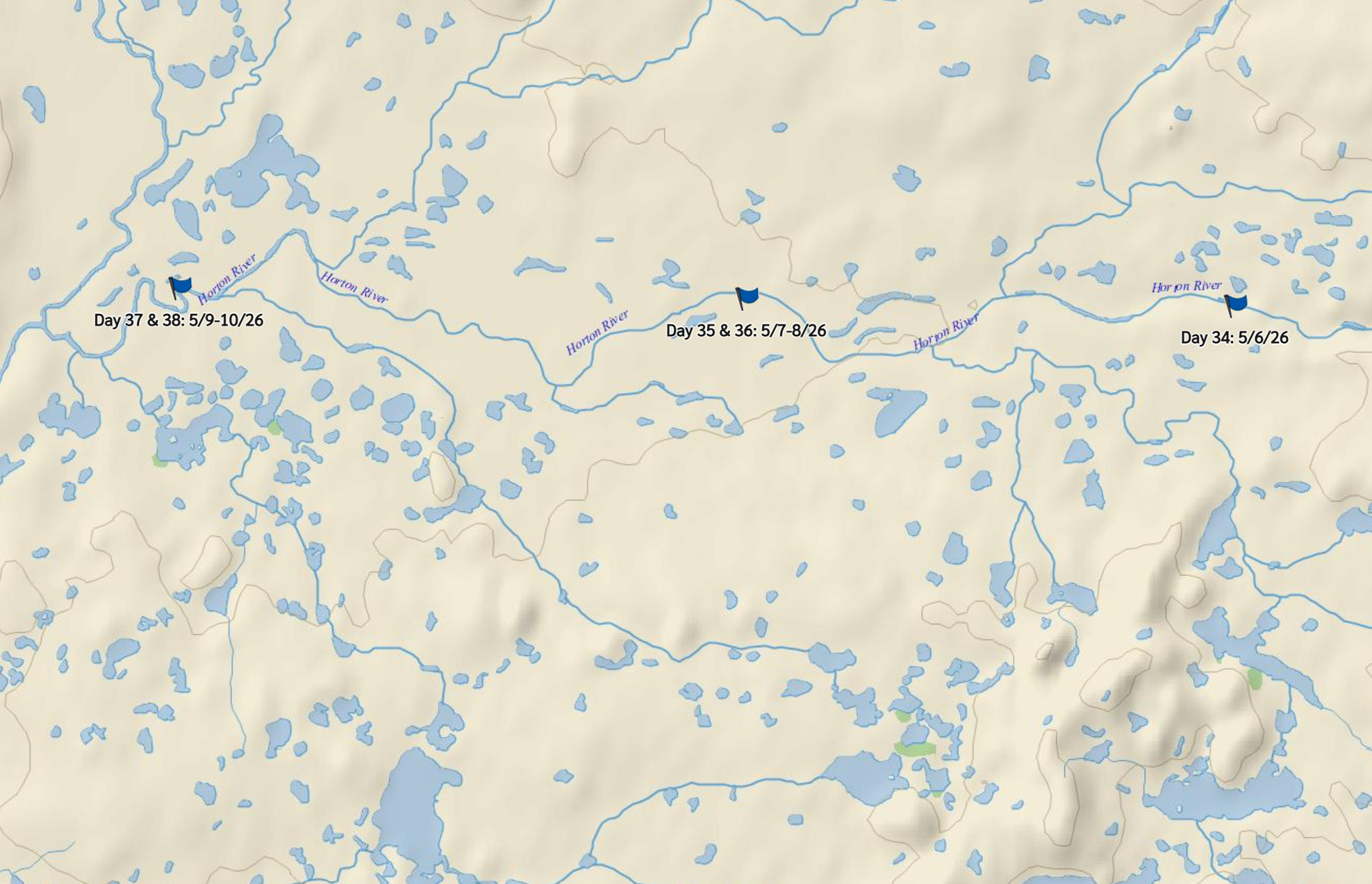
Slushy conditions on the wetlands make travel “worthless” in today’s dispatch. Visit Will’s interactive map for complete control of magnification and orientation.
Will describes spring river breakup in today’s dispatch. The latter part of this video, from the 2007 Baffin Island expedition, illustrates overflow and the challenges it creates at this time of year.