
Day 66: June 7, 2026
Using a rest day to rethink his plan and extend the time and food necessary to preserve his core energy, Will adopts a new strategy for traveling at a lower elevation that will make stream crossings the major challenge ahead.
-
Yeah, Will here on June 7th, day 65. I've been recapping, kind of putting in context where the day was, but just because of the energy problem, probably low on batteries, if you want to put in context, this is like day four of this hike out, so I'll just kind of take it where it was.
I talked about on the second and third day, I end up in this really deep, crusted slush, slow, unusual condition, very difficult. After the first day of that, I was totally worn out, and looking forward, I was on this dome that was flat, and this is getting worse and worse, it's up to my knees, and there's no place to get a rest. It took me 20 minutes to find a spot where I could pitch the tent that night, and I did have some deep concerns that evening, and I was totally exhausted, went to bed at 11, 11:30, and then I woke up at 3:30, real tense. I mean, the worst situation is to lose your, kind of lose your balance a little bit. I mean, that happens a lot when you're in debt or you've got a big problem you've got to solve, you wake up at that time. But whereas the peace and deep sleep are essential, as important as food on expeditions like this.
But it was a time of soul-searching for me because I had to rethink my situation. I was dealing with a flight that was going to bring me back to the realities of life and my responsibilities on the 12th of June, and I realized that I was not going to make that. I was also becoming timeless, becoming into my life the clock, and the clock causes so much problems in our life, all these deadlines and that. And I immediately could change that by just making a call to our office and pushing that date up—because that's reality—to the 16th of June.
But the serious part of it was I had this heavy load, about 80 pounds, and this post-holing, it was just utterly beyond exhaustion, and I had a worse day ahead of me. And what was starting to happen was I was starting to burn my core energy. And early on like that. I'm in superb shape. I heal real, I mend real fast. But then at that core energy, if you burn out, it takes time, rest, and food to come out of that. You're usually at that at the very end of a long expedition. Neither of those two, time or food, I have a lot to spare.
So I got my act together that evening. I managed to get a few hours of sleep. And then I crashed through that second day, managed somehow to get through that two miles. And then I made a decision, actually before that, that I would take the next day off. And there was no question around it. I started descending. My goal that day was I descended on this dome on the northeast side. It descended kind of fast. So I got out of the major snow. I crossed the stream, my first stream crossing. And then made camp here. And then I slept 13 hours, very peaceful sleep last night. Deep sleep. And I got my act together.
You know, you know, day four here, people look at the map. And I'm not even out of the gate yet with this huge distance ahead. And there's some people that might have concerns or naysayers or Monday back quarterbackers. There's a lot of people like that that would do something different or whatever. The situation here, you can't study this in a map or a satellite photo that would give you an idea. These conditions are totally different like anything on an expedition. You think there will be something in the weather, conditions, rain, whatever it might be, changes. And you just have to change your strategy rather than being a failure and changing your plan around.
But I got a schedule all worked out to the 15th. I went through all my food, which is not a lot. And I actually made a menu plan. I run out of food on the 15th. Just to get this all down so I don't have to think "how many cups of oatmeal do I have left?" I just got it all out on a menu and enough that I can get by on. And the important thing on this, you can be a little short on food, but as long as you're getting that, you're staying in that moment, you have that quiet mind, meaning you get a peaceful sleep. You really should be sleeping like I will try to do, sleep 10 hours. When you're exhausted at the end of the day, you're not ... I get enough nourishment, but I could eat about three times more. But as long as you're calm-minded, you're not burning energy out, and you get a solid sleep, then you're a new person, your body mends.
And I'm not taking any medications or Advil or anything right now. I took Advil the first three days just out of precaution. But I find something like that, I'll take Advil if I do have muscle strain and inflammation. But that upsets your digestion or whatever. It throws your body off a little bit. You have to be on these expeditions really fine-tuned. I'm not against any type of drug, especially like an Advil—it's a miracle drug. Sometimes when it's inflammatory, you pull a muscle and that. So I'm just doing it very, very simple.
And so we'll see what happens tomorrow. The terrain here is much better. I'm basically traveling on a divide between two great rivers. There's the Horton River, which I've been going down, and that's to the west and to the east side of the divide is the Hornaday River, another big river. That's a national park. The divide runs north-south. So I'm on the west side of the divide. In other words, before on that dome, I was heading down on the east side where it doesn't get sun. But the west side gets the sun. It's melted a lot of the snow, not so much on the higher levels. The divide here also is not a divide like a shut divide. It's more of a rolling, high-hilled divide, kind of like it is here, kind of dome-like. It stands up. It would be perfect hiking if the snow wasn't there.
So I'm on the west side. I took a little bit of a hike. The terrain looks good. The problem right now is because of the snow at the higher elevation where it's perfect hiking, I'm forced to go lower. In other words, I'm going to have to cross, make some stream crossings. My strategy at the beginning was to go high, avoid all that runoff that's coming out now. Now I'm forced to go to a little lower elevation where I have to cross these streams. And I'll learn a lot more. I've got two kind of big, not real huge streams, but they could be questionable to cross tomorrow. But I'll learn this tomorrow, these streams. Sometimes you have to go up higher if you can. Or they have tributaries and just take ... cross the various tributaries rather than one river. So the study of the next couple days, three days now, are the streams. I have a major stream crossing. They call it a creek. But it's not a creek. It's got a name. Anything that's named is not a small creek. And that's up about 25 miles. Now I'm working on how I'm going to cross that. That's a major obstacle. But I'll have more knowledge and more, more of my mind on the conditions by that time. But my energy is good. And I'm totally looking forward to taking off tomorrow. And we'll talk to you tomorrow on June 8th. June 7th now, day 65. Over and out.
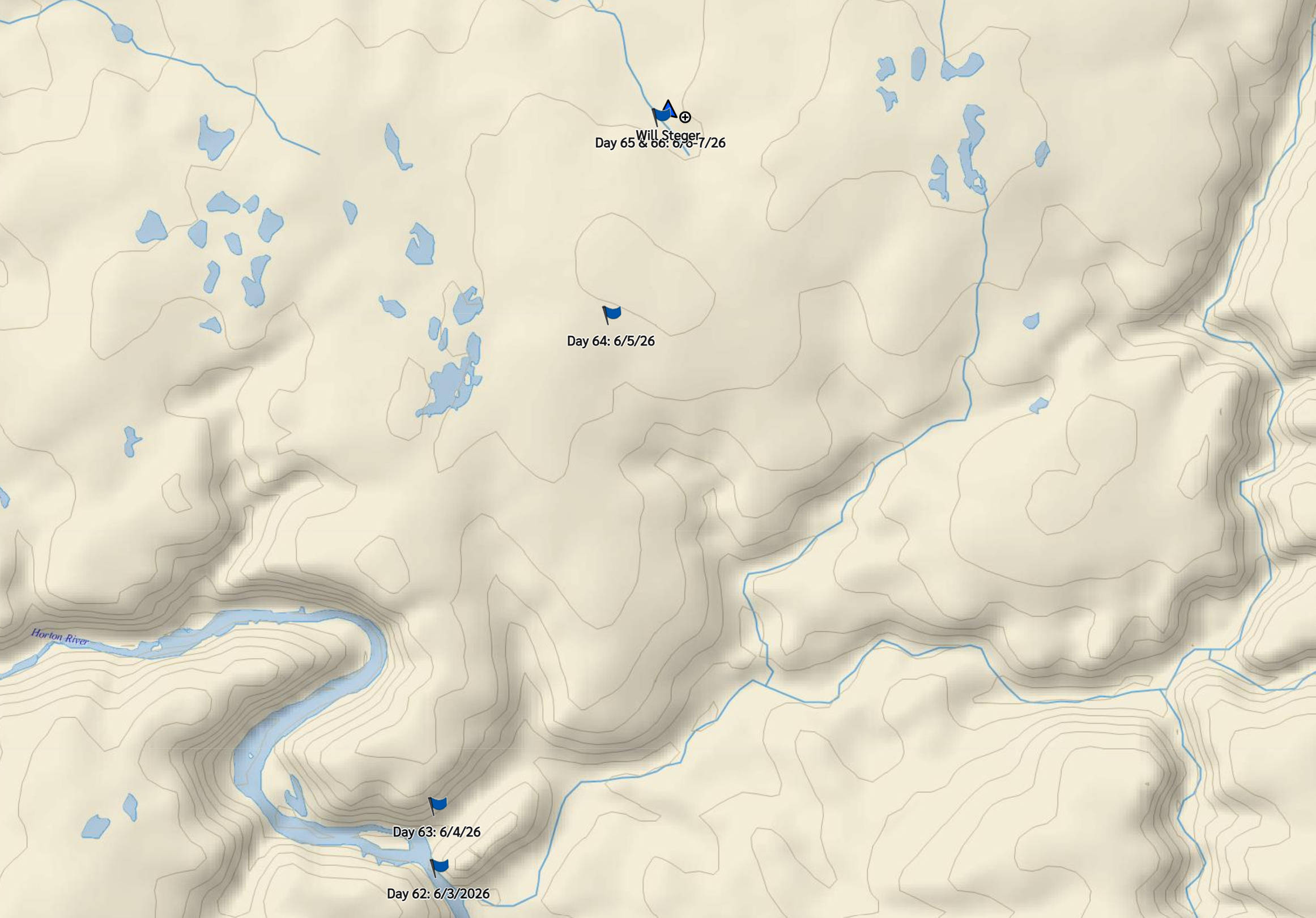
The new strategy will take a route along the divide between the Horton and the Hornaday rivers. Visit Will’s interactive map for complete control of magnification and orientation.
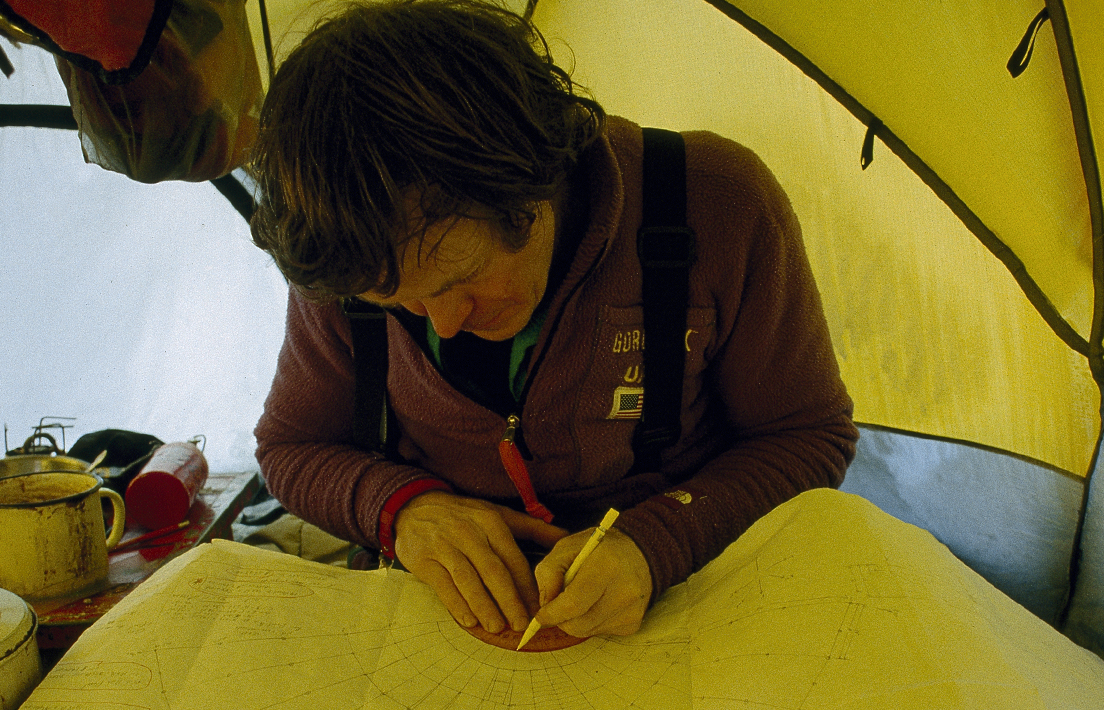
Sometimes rethinking is required. Here Will begins to imagine the Steger Center while waiting out a storm during the 1989 Transantarctic Expedition.