
Day 57: May 29, 2026
Will packed up camp and launched his raft into the flowing Horton River, putting in four hours of challenging river navigation that culminated in a gutty decision to shoot an ice channel rapid.
-
This is Will here on May 29th, day 57 on the Horton River. A little excitement today. I got up going around 8, 8:30, and there's a north wind at that time. It looked like a regular day, but the wind shifted around the south, so it was kind of a mild day, fortunately, and not really super warm, but really comfortable for packing out. And I had a lot to pack out. I had fully packed out my hiking part of this expedition in separate waterproof bags. The food, the gear, I did all that during the last two weeks. But it took time to get everything ready and cleaned up and packed and cleaned up the camp, get everything down by the lake and the river and organized.
And by around 3:30 or so, I was down there, and it took about an hour to systematically get everything into the raft. The raft is an alpaca raft. One of the greatest rafts around. They have all sorts of types of rafts, but this one's a whitewater. It's about eight or nine feet. And the gear, all of those inside the tube itself, it zips down on the front. So it took a while to get that arrangement done. And then I double-checked and triple-checked the camp. I was a little pensive, I was always ticking off on situations like this, a totally unknown about the ice and what was going to happen, and a pretty natural feeling. I always know that that's a normal situation. Once you get on the water things become normalized again.
There wasn't much ice going down. And if there were streams of ice, like when the dams broke, you just can't go out in that. It's like running around in traffic. You just don't do that. Or some chunks of ice didn't matter because they were single pieces. And then once I was out on the water, swift current, these chunks, you're traveling at the same pace as that.
But it turned out the area where I camped in was a great place, protection and everything. But it was a real calm area down below. It was a much different story. Huge amount of ice, both shores, you know, six to ten feet of ice on both sides of the river. Huge piles on sandbars. And it was really a wild type of a scene. Lots of learning experience right off the gate. There was a south wind, which was great because that was going with me. This is going to be a tough river if it goes north wind. The south was to advantage. It was really blowing hard. It was gray. It almost looked like it was raining, a different weather than what we've had. It seemed like a regular kind of a warm gray, maybe rain. There wasn't a sense that that north was just looming again. But the gray being in the afternoon, it made it a little difficult to read the river because of ice on both sides, kind of a grayish ... and when you made it around bends, you couldn't tell any definition. It looked like it was all ice. But then when you get close, you could see what the bend was. And so it was actually challenging. And my big concern was, were these bends, were they jammed up and so forth? And it was a learning experience. And in some areas ...
The main thing when you're traveling like this is you're always looking forward quite a ways to read the river. You see, when you're going to a curve, the inside of the curve is where there's current. That's what you've got to really be careful of. The outside of the curve or the outside of the curve where it bends on the outside, that's where the current. On the inside, it's a little bit calmer. But on the inside curves, there's a lot of piled-up ice. So you want to look at places where you could kind of duck in. You're looking for eddies. Eddies is like there's a sandbar. There's an eddy. It's like a reverse current. You can get into an eddy and just get the protection there before you make your next move rather than going straight into something.
So the main thing was to try to get, as you go down in steps kind of, you've got to get, look ahead. And in the meantime, you've got to deal with what's going on right in front of you. So my plan was not to go long, three or four hours. And it was getting towards the end of the day, and I got into a really Glory Be situation where ... I won't go into too much here. But I found at the bend, and I was getting into this huge ice, this ice that was overflowed, that flowed over the winter. The stuff that was thick to the bottom, 10 or 12 feet, well, that ice was still on the bottom. And when the big dam broke, it flooded that. Now what's happening are these huge pieces are popping up from the bottom of the river. So you're dealing with these huge blocks, and they block the river.
So I got into a situation that you don't usually want to get yourself into. I was in two channels and three, and it was a hard time reading it. And I was trying to find an eddy to ... get ... and I finally got behind a huge block of ice that was submerged and had other blocks on top of it that I could climb up on. And this thing was about the size of three or four basketball courts that zeroed down. But then right in front, the whole river went into this chute, which, I didn't tell ... I expected anything.
So I had this decision to make to try to rip my way upriver through these blocks of ice that were submerged. It was still questionable. My goal there would have been try to get upriver enough to try to get the shoreline on the other side. But that was where the swift current was. And I was in two feet of water there on that block. And the wind was really hard blowing against me. And I really felt that if I ... I just didn't have the time. I mean, I couldn't overnight. I couldn't even wait anything. It was really, it was a hypothermic (not instantly), but when you get that way within hours yout decisions are not good. And then the other decision was just to shoot this thing. And all along when I was trying to get up on these blocks and get a sense of where I was at, I was watching the chute all the time. And there's big waves. It went into a chute. Then there was a blind spot that I couldn't see. That was the problem.
Then downriver I could see that it flowed out. But the question I had is, did that fly, flow under ice? And I was, you know, 99 or 98 percent sure that that chute did not go under, there wasn't any ice. It was just a chute with waves and blocks of ice on either side that were making the waves. So I made the decision to shoot it. And I just systematically, you know, inflated the raft more. I did the various steps. These are situations you don't want to be in. But I just, I knew I could do it. But I was not calm. You know, I was just, you know, I was on my edge. And, but, I was confident, not cocky confident. But... And, and so I shoved off into the waves, into the chute.
And that's just where your skills kick in. There was waves ricocheting off of a big blocks of ice. Almost like a little canyon. But, it's the right thing ... Your skill level, like I've been doing rivers all my life and reading water. I'm a little new on the raft, but the raft really manages well. And I managed to get all through it and down on the other side. And fortunately, there was a rock, big gravel bar that went out from land. And it was really hard to find any place to get into. But there, on this, there was some grounded chunks of ice, about six feet blocks of it. And then I got in between these blocks where it was calm water. And I got up on this rocky gravel bar about three feet above the water here.
And I made a, made a camp and stuff like that and got warm and about to have my dinner and everything like that. So, so it was a, it was a great, it was a great thing. And I'm not telling you the whole story. I'm kind of dumbing down, I don't want anyone panicking. So, you know, I'm getting what I wanted here. The great thing that's happening is that even within 12 hours, you know, this ice is really eroding quickly. There's a lot more unknowns up ahead. The main thing is I know that they can pinch down like that. And then I'll be traveling tomorrow, maybe around 11, when the lighting is better. Because I couldn't read the ice properly and the experience I just had in four hours here. And this is it, then, and I'll talk later on. Bye-bye.
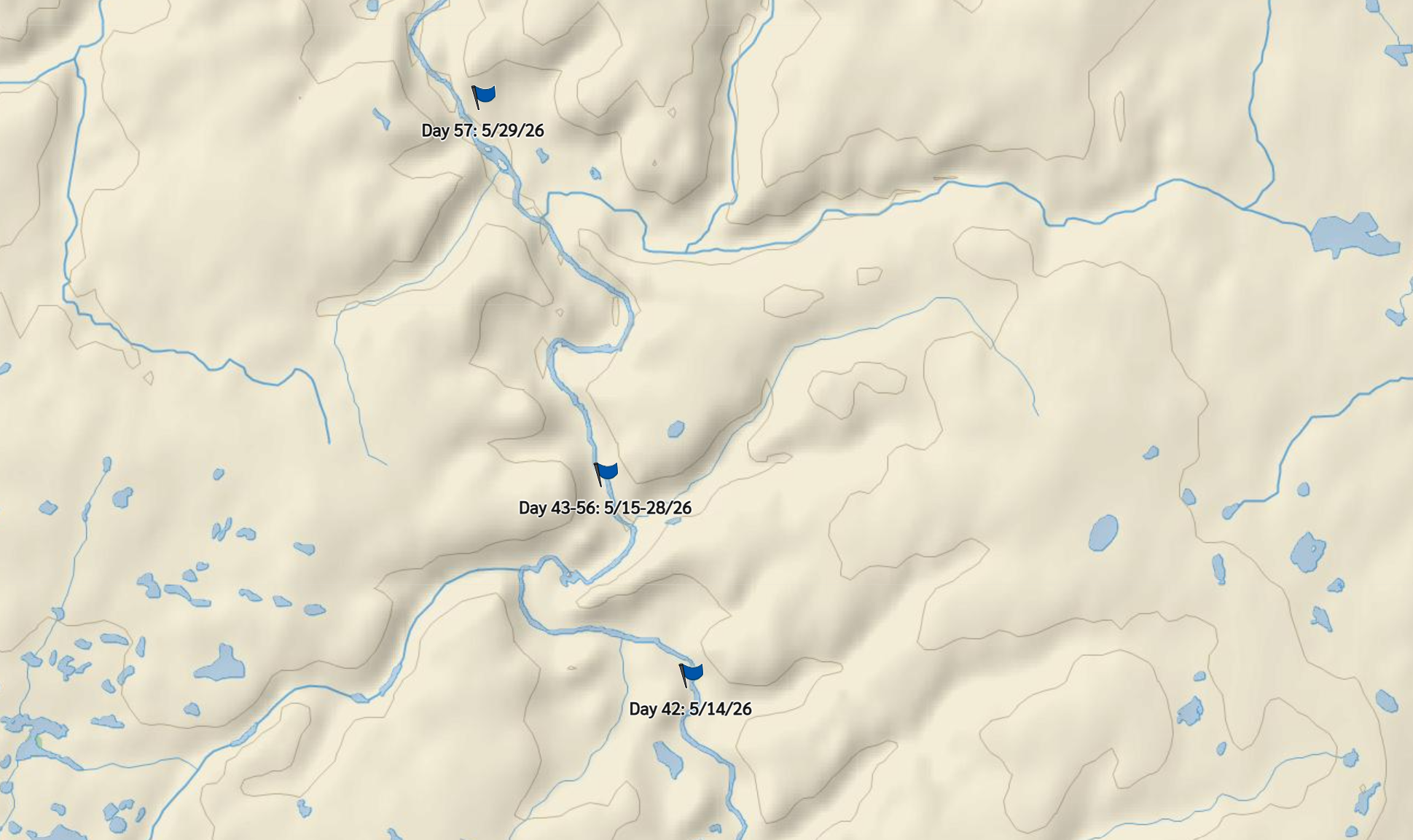
After 14 nights camped in the same location, Will is underway again as the whitewater phase of the expedition begins. Visit Will’s interactive map for complete control of magnification and orientation.
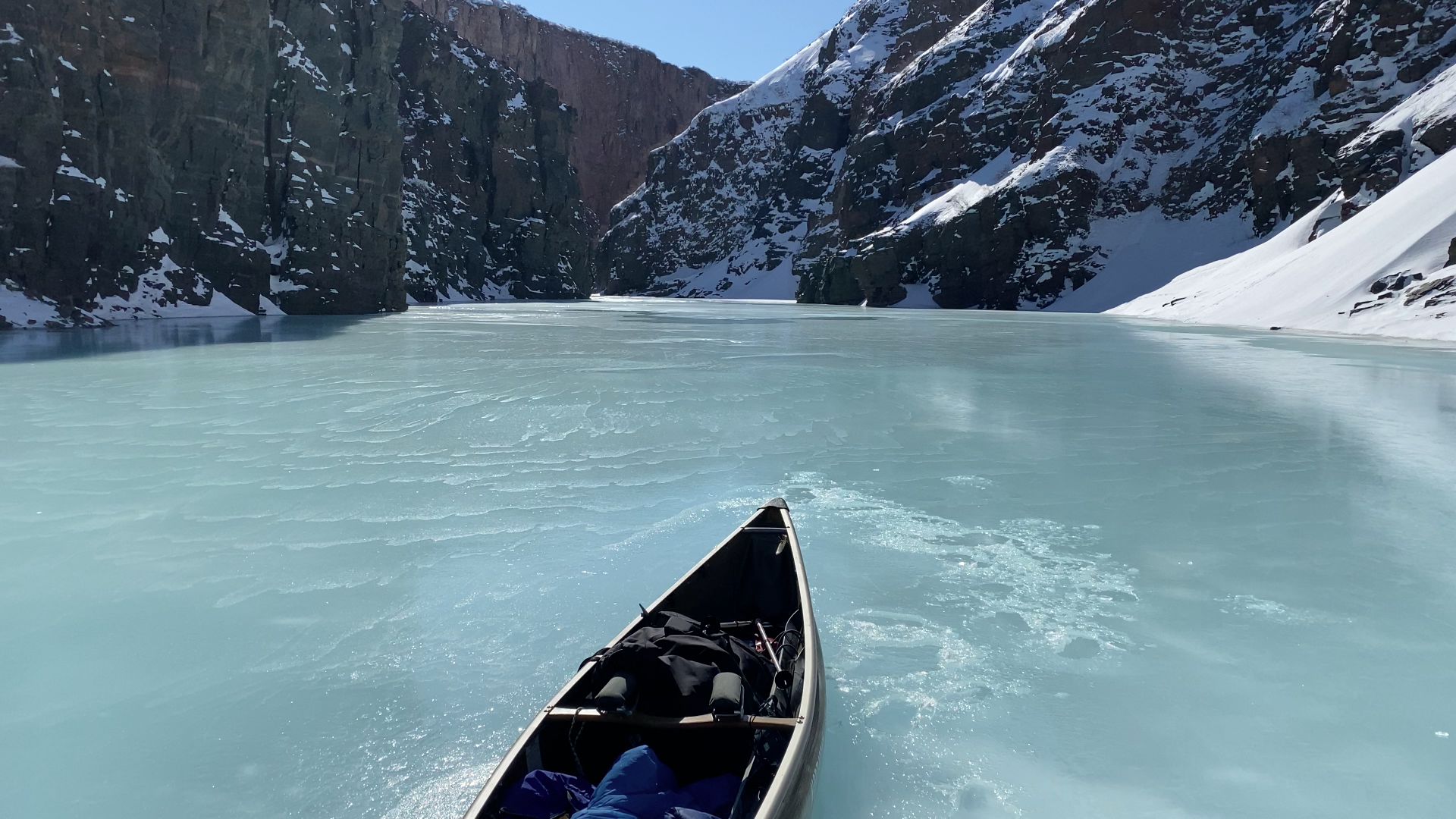
Entering a canyon with the canoe sled on the frozen river during the 2022 solo expedition. For this year’s expedition, Will is traveling to the now-flowing Horton River’s canyonlands on a whitewater raft that he described in the previous 2026 log post “More of My Gear.”