
Day 52: May 24, 2026
Cold, overcast weather from the Arctic Ocean provides the backdrop for Will to continue recounting the inception of the Steger Center and the remarkable circumstances in which it was first imagined.
-
Hello, Will here. It's May 24th, 26th, day 52. I'm in day nine of the wait here for the ice. A few days ago I was getting in at the Steger Center. I did the origin story. Unfortunately, we had a technical problem so I wasn't able to do a [... ...] on that. But what I'll do today, just a brief summary of the day, which ... and then I want to talk a little bit about the history of the Steger Center, where I came up with the idea, and also the case study that I did for it.
And today is a day of clouds, north wind, cold, windy, no sun, same type of Arctic ... it's actually Arctic Ocean coast weather that came in from the north. Kind of tough weather. My tent really warms up in the sun, but these tents, the clouds are so thick there's no radiation. So it's been cold in the tent outside. There's little signs of some sunshine. And the river is partially, 20% open, still in the process of deteriorating. And I'll get into that more later in the next couple days.
But the last time I talked about my origin story, I wanted to talk about where I got the original idea of starting this Steger Center. And I mentioned an origin story. I started a school. I moved to the wilderness from the city in 1970 to Ely, where the center and where I live now was three miles of two lakes from the nearest road. And in the livelihood there, I started a winter dog sledding and skiing school in 73. And I was able to develop my own programs. It was very tough. Like any business, I just started really hard going the first couple years. But it really took off because this idea of using dogs had never been used in the winter before. Outward Bound started using dogs 10 years after that. And so it was a success. In fact, I could have done that the rest of my life, made a good living at it. But after about seven years, I was not reaching the numbers I wanted, maybe 50, 60 people a year. And I really had a much bigger vision of what I wanted to do with my life and education.
And it was around that time in the very early 80s, I had the idea of building a center in the wilderness to influence higher-level leaders. And I felt if I could do that, I could make the biggest impact of my life. But that was not all thought out. But what was critical here was I had this intention. The thought was there. And considering that, but it was in the very back burner. I ended up giving the business away on my winter school in 1982. And then I branched out. And, first of all, unsupported expeditions that I financed myself. 82-83 I did a year-and-a-half expedition, traveled about 6,000 miles by dog team, got more and more experience.
Around that time, I realized that the North Pole had never been done unsupported. That was something that all the authorities said was literally impossible. And I knew at that point that I was a person, that I could do that. So I continued these expeditions. And then in 1986—or 84— I started recruiting the North Pole expedition. And I knew if I was able to make that, I could really launch my career at a national level, which would be needed for the center. The North Pole was a total success. Six of us made the pole. It was all six of us. It was 40 years ago on May 1st. You know, it really opened up the world for us.
And I started working on the environment and nationally in education. But it was happening along the way of the North Pole in 1986. We were a month out, 200 miles in the moving, shifting ice of the Arctic Ocean, larger than the United States. The only other person out there was a Frenchman who had left right around the time we left to do a solo. And I felt [... ... ] he's a quitter. You know, I figured he tried it a year before. But about a month out Jean-Louis Étienne, the Frenchman physician, him and I literally ran into each other on the ice. I mean, it was just phenomenal. And I made an arrangement that the next night that he came along when we were camped. And I went in his tent that night to talk with him and meet with him. I brought a map of Antarctica. And we talked about what was our next project. And I said, way across North Pole, I want to cross Antarctica the longest possible route. So he was [...] by this route, and he looked up at me and he said, "Well, I think you'll need a physician, a doctor for this expedition." So right at that time, which was the beginning of this Trans-Antarctica expedition, and we laid it out in that tent.
North Pole was a personal best. And we talked about retiring on a personal best. But the Antarctic Treaty, Antarctica was governed by a treaty that was signed in 1960. And probably the most incredible in the national treaty. It set the whole continent aside for science only. No military, no military. It opened in cooperation around science. But they had a clause to open it up in 1990 to see if there's any changes. Well, behind closed doors, right before this North Pole expedition, the 27 treaty nations drew up a formal document to open up Antarctica in 1990 for mineral exploration. 27 voted for it. All of them, it needed unanimous vote. So we thought we would just make this expedition. And our goal was to reverse all 27 votes. And this is the beginning of the Trans-Antarctica.
And what I did want to talk about was the case study of small leaders, small teams of leaders can change the world. I mean, that's been a quote out there. I mean, I didn't get this from a book. It was my idea I had. But my case study on that, actually looking back, was Trans-Antarctica. These two guys met and decided to do this expedition to draw world attention and change the whole 27 votes. Well, to make a three-year story very short, we developed an incredible diverse international team. Jean-Louis was a diplomat. We got the Soviet Union. This was during the Cold War. And China came on board in a very big way. The Soviet Union was actually partners of ours. They invited us to Antarctica Logistics. And as part of this, we had an office team. We had three offices, one in St. Petersburg, one in Paris for Jean-Louis, and one myself in Minneapolis. And we developed an educational project for this. We reached, actually, in the end, 16 million people, kids around the world, documented on the Internet. It was a huge media event, and that was the idea, was to draw world attention and to get the constituency of [... ...] influence the leaders. And then by providence, Antarctica had never been crossed without ... by [... ...] you know more. And this was the longest possible route. But by providence, we were able to make it across in 220 days and 3,700 miles.
In the end, we traveled around the world, we met with world leaders. And we were not the only ones working on this. I mean, the huge diplomatic effort going on, that is a case study in itself. There is actually a book, "Who Saved Antarctica?", about the diplomatic effort that went on. But the diplomatic effort was not working without getting the world leaders on. And that, through work in Washington D.C., long story short, with a year and a half of diplomacy, we managed to reverse all 27 votes. And Antarctica was set aside now for no mineral exploration and science only. And in order to reverse that, they have to have a full unanimous vote.
I bring up Antarctica because this whole experience of crossing Antarctica, and it was during the crossing that I drew up the designs for the Steger Center itself. But this whole effort of Trans-Antarctica really empowered me to start this 40 years ago, or it was 30, 36 years ago. And I realized I could do this. And then in 1990, when I got back, I started the building, which I funded up until about three years ago, raising ... working and the building itself. And in the last 36 years, developing a nonprofit, ClimateGen, and a number of other nonprofits. And other efforts that helped me to this point of credibility. So long story short, and tomorrow I'll talk more about the actual Center and our principles.
[audio cuts out before Will can sign off]
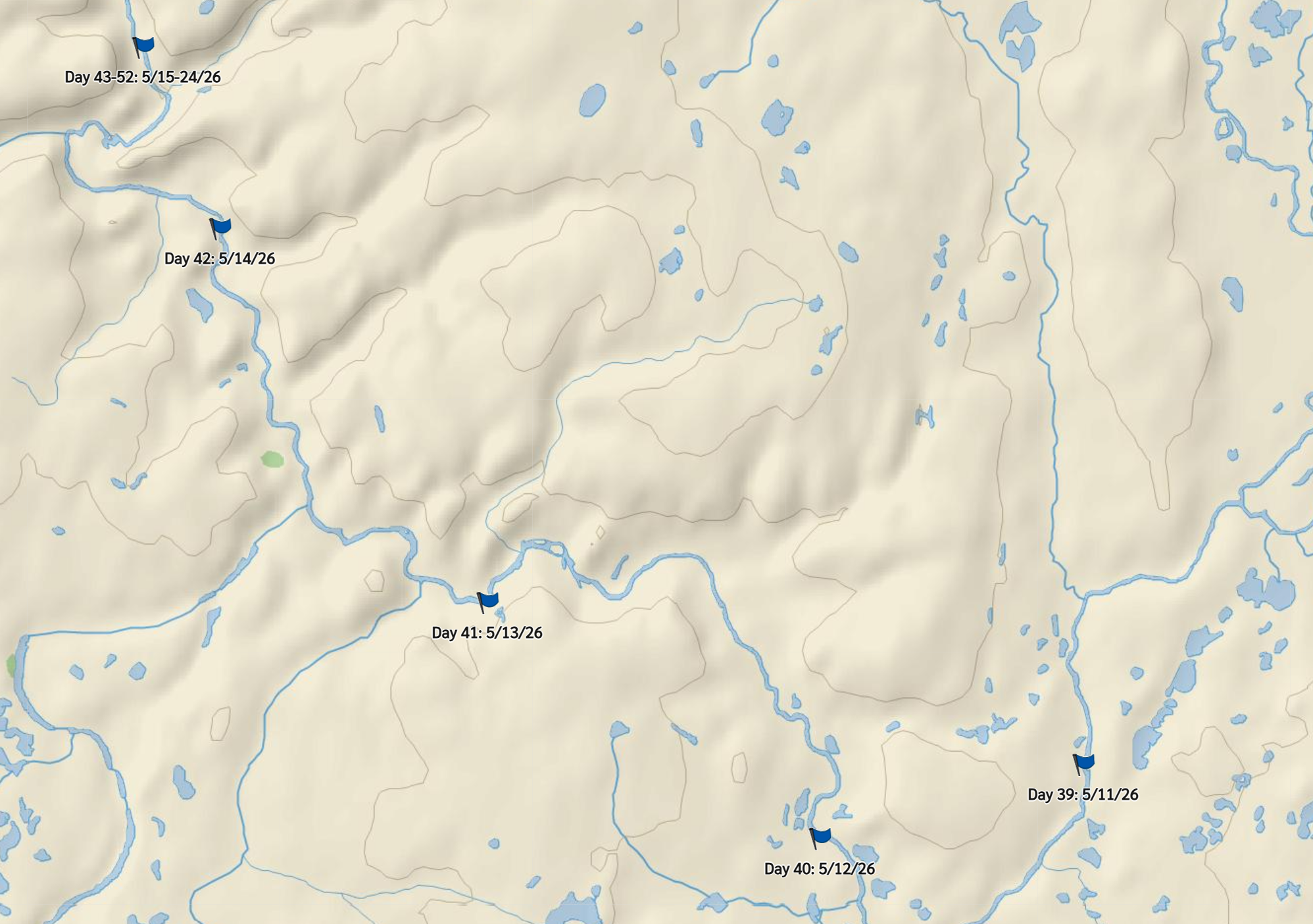
Will’s position is unchanging as the thaw continues and river breakup unfolds on the Horton. Visit Will’s interactive map for complete control of magnification and orientation.
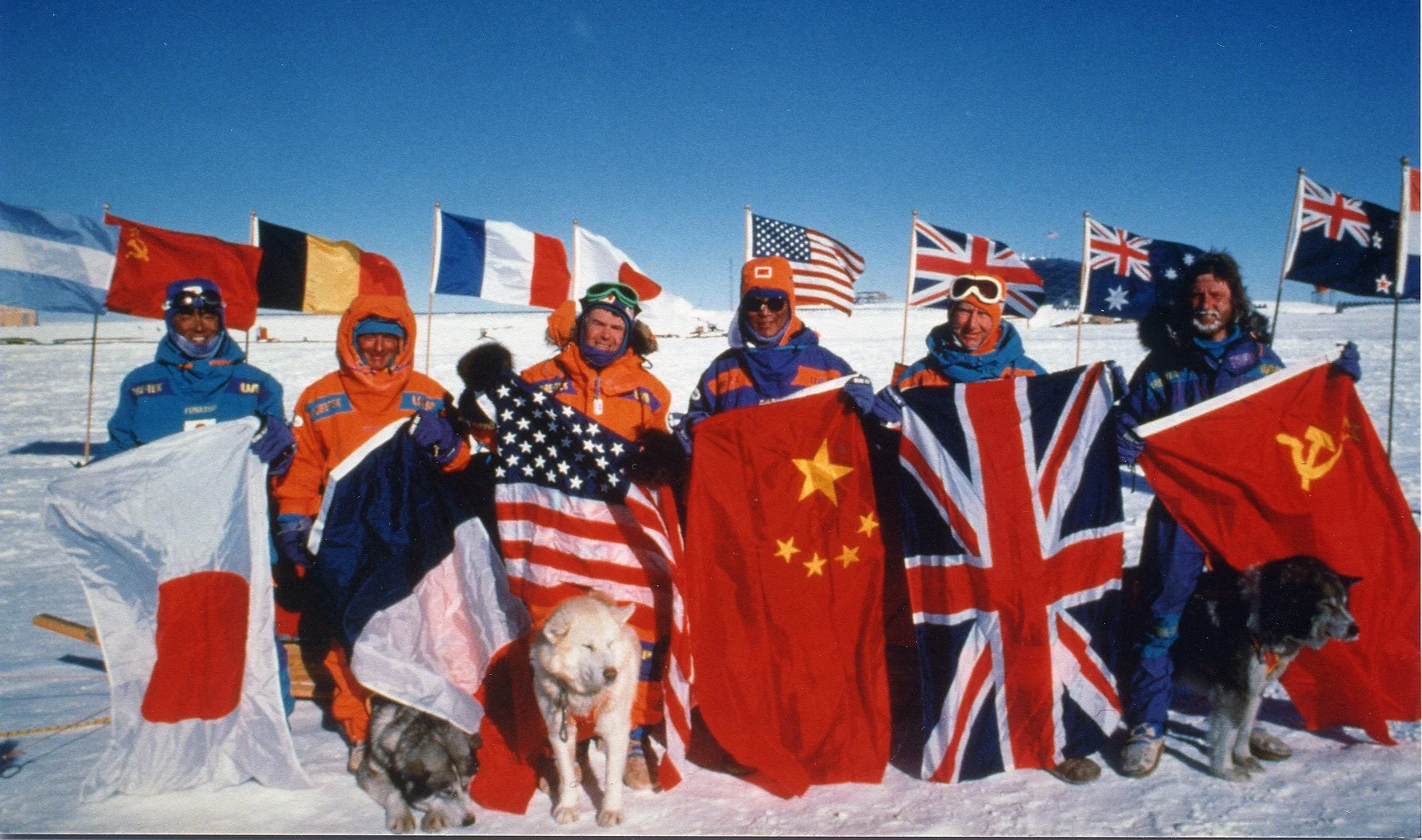
The Transantarctic Expedition team—Keizo Funatsu, Jean-Louis Etienne, Will Steger, Quin Dahe, Geoff Somers, and Victor Boyarsky—halfway through the historic journey in 1989.