
Day 32: May 4, 2026
After days of travel in whiteout conditions or waiting out storms, some afternoon clearing produces a "totally clear" and "absolutely gorgeous" afternoon. Will is hoping to make 5 mile straight-line progress daily while still relaying, and keeping an eye on the Horton for signs of navigability.
-
Yeah, Will here, May 4th, day 32 on the Horton River. Covered 15 miles on relays, in other words, about five miles in a straight line progress today. It was warm overnight, and I see it was thawing a little bit in the morning. And it looked ... at least I was optimistic, and the clouds looked like it might lift. It was ... it lifted a little bit. I mean, you could see the tops of the ridges in the morning, and then I was hopeful. And then about 11 o'clock, the wind came up from the west, full wind, and I thought, well, another day. Then about 2 o'clock, a nice strip of blue appeared on the western horizon, and right now it's 10 o'clock. I'm just melting some water here, snow, and it's clear. It's totally clear. It's just absolutely gorgeous afternoon. The wind died down. The sun had an incredible intensity to it. There's a huge crust that formed today. And so things are looking up that way.
It looks like a pretty stable system. You might get ground fog in the morning from this, and you never know, but there could be a good weather spell. But a couple of clear days with the intensity of the sun could be a game changer in a number of ways here.
It was the first time in, I think, 10 days at least, that I was able to see the ground when it did clear up around 2 o'clock, and I could see the snow drifts, everything. The last 10 days has always been a ground whiteout. And you can't tell if you're going up or down on a drift or choose a route, basically, which makes it a little bit harder. But it was just a beautiful, very optimistic...
It's kind of a wide valley. There's 100-foot ridges on either side that rise up pretty fast. And it's basically meadowlands, with this little stream. It's still maybe about 20 feet wide. It's, of course, frozen, and it's drifted over. And if you look at it close on the satellite photos, you'll see that that little stream follows, and then there's little long ponds along the way, that goes into these ponds and then back to the stream, back and forth. And there's actually some thawing of the snow on the ice on these little ponds.
But the conditions got really good travel in the afternoon, pretty fast. I'm still double loading it. It's just a little bit too much to do the full 200 pounds right at this point. It's easier to do it in two trips, you know, one forward, ski back with no light, you know, no load at all. Rather than just burning out, try to do it all twice, you know, one, once at a time. So I am relaying for now. It's kind of setting a goal of just doing this every day, making a five-mile straight line progress. And let's get some maybe elevation drop a little bit. Get particularly a little bit more volume of small streamlets and that coming into this river. So if it does start thawing, there will be some water, maybe navigated water. It might be down the line.
But it's just wonderful here. I'm sitting in the tent. It's about 10 o'clock. The sun's low on the horizon. It virtually isn't ... you know, the stars aren't out much, I'm not around at 1 in the morning to look at them. But the sun comes back up about 3. There's a prolonged, beautiful twilight. It's really a beautiful time of the year.
And the western Arctic, like here, does get really good weather spells. Spring, spring is actually a pretty good season here, pretty stable. You can get the spring storms, conditions like that. But then again, this is kind of a little bit of an unknown area for weather-wise. It's, you know, it's high elevation. Not high for mountain standards, but, you know, 1,500 feet. But that's high for ... makes a big difference in temperature. And it is a divided country. So there is an ocean on one side and, you know, a forested area on the other side if you go down. So it is a major divide in a way. But there isn't much information on, you know, just the weather here. But I take it, you know, you do get the good spring weather.
So anyway, I've got to get my dinner on and get everything going, and I'll check in tomorrow. So, you know, everything's looking up here. And this is Will, May 4th, day 32, over and out.
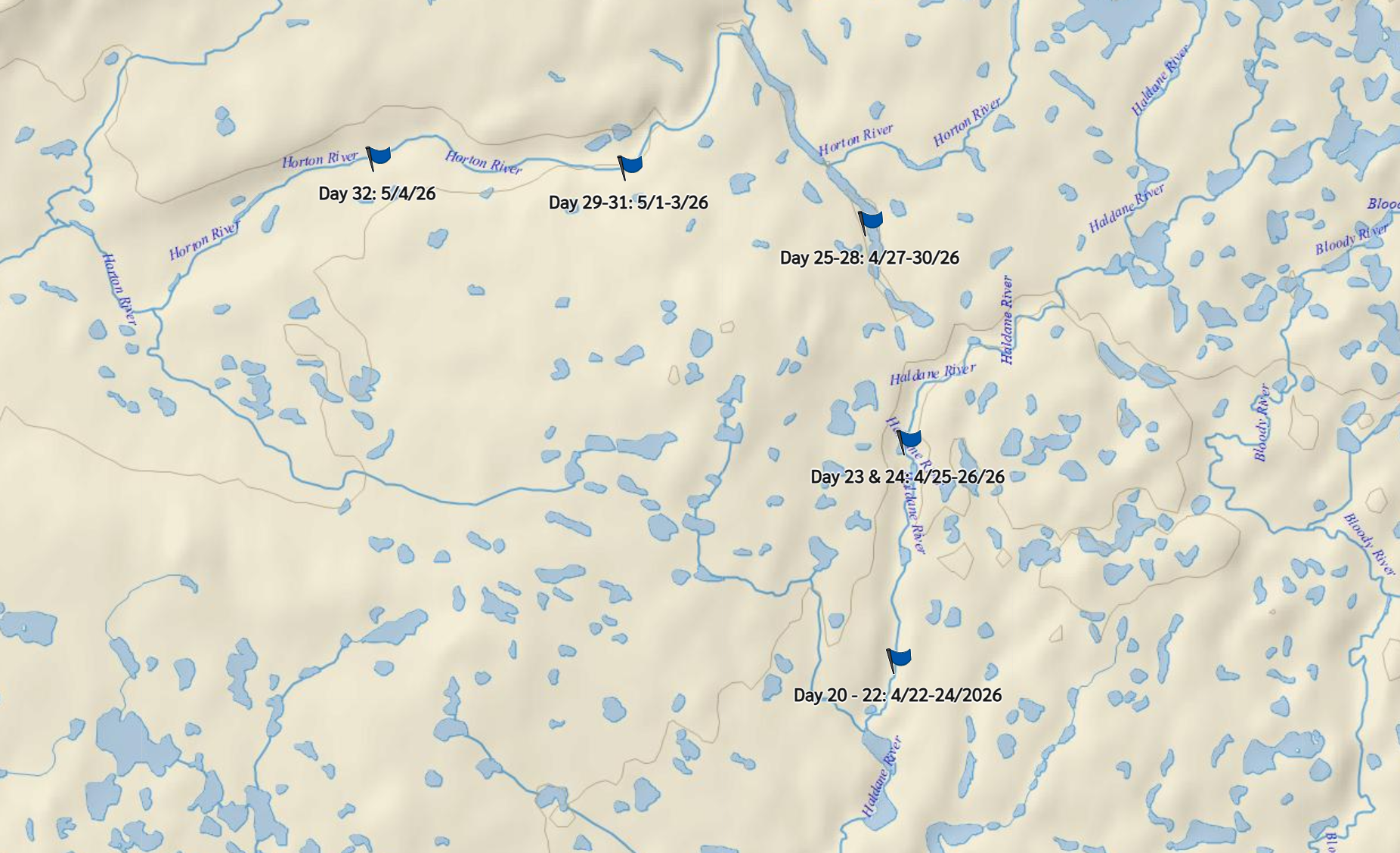
Fifteen miles of relaying led to 5 miles of straight line travel today. Visit Will’s interactive map for complete control of magnification and orientation.
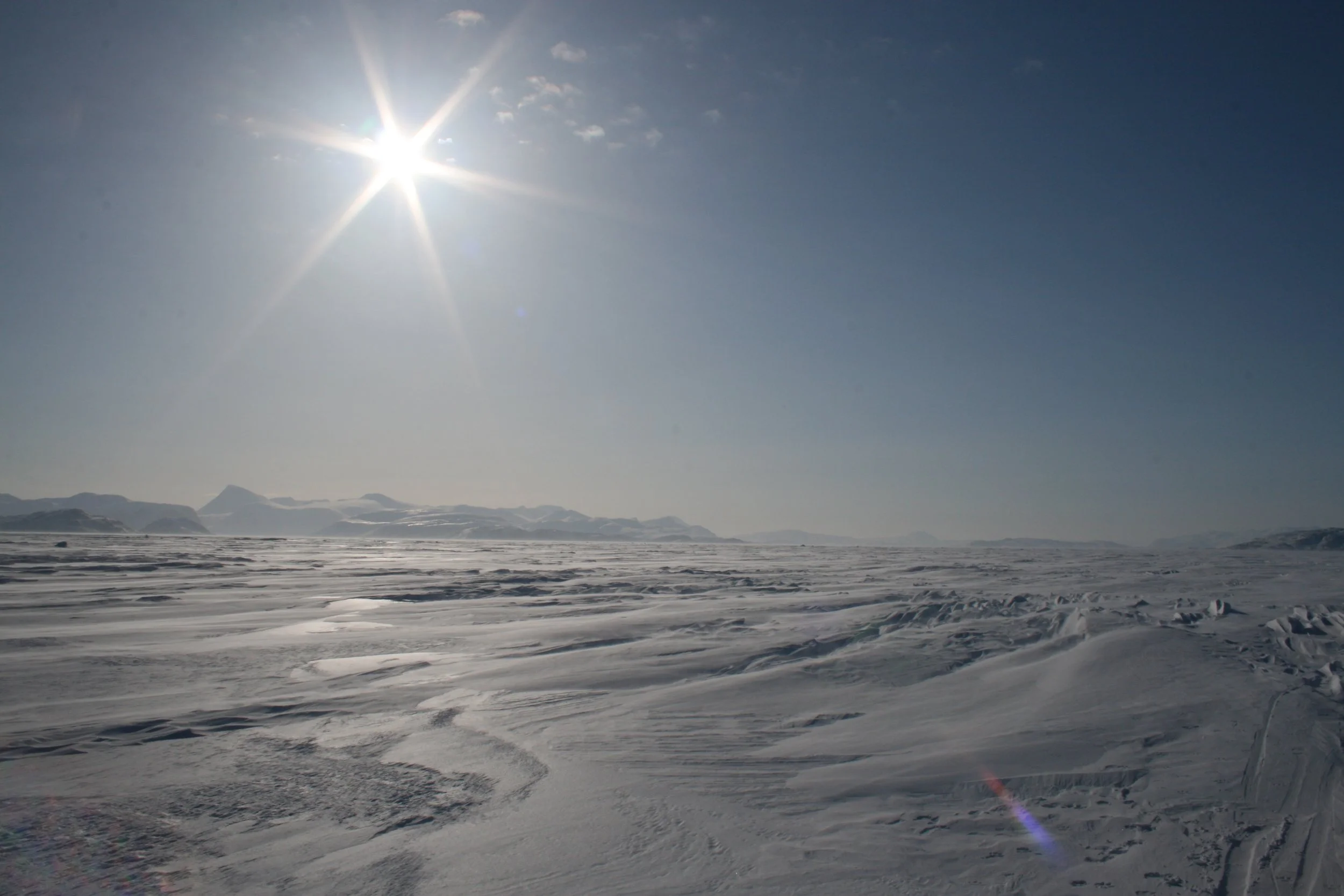
Morning sunrise over a frozen lake on the Baffin Island expedition, 2007. As Will’s dispatch today relates, clear skies and a view of the sun have been infrequent over the last 10 days of this year’s expedition.