
Day 26: April 28, 2026
It’s been a grueling 25-day push as Will takes a day off and plans to rest and recuperate while also contemplating the “1508 feet of high adventure” awaiting him ahead in the spring breakup.
-
Hello, Will here, April 28th, day 26, on the headwater of the Horton River, at least the headwater lake. The elevation here is 1,500 each feet, which is pretty high for this part of the Arctic. And I arrived yesterday. I had an incredible storm that I traveled in all day, whiteout, and that was pretty exciting. It wasn't a dangerous storm. And yesterday was warm temperature, you know, in the 20s, and the visibility was pretty down to zero most of the time. And then I relayed, and then I stopped at the headwaters in the evening, and I just had just an incredible sense of relief when I managed to finally stop. I've gone pretty much 25 days straight on nonstop to get to this height of land. And every day I had no idea what was going to happen. And it was a tough go—12-hour days. But it was just a huge sense of great feeling that you get on an expedition.
And I looked at my sleds and ... three sleds, and the size and still the weight that I have, it was just amazing. You know, not even halfway through the expedition yet. But I did bring up plenty of extra food. That's why the difficulty of getting up this far. You know, in a straight line it might be 65, 70 miles from the Great Bear to here, but that river is twisting. And I did everything a minimum of twice and sometimes three times. But it must have been 280 miles I did in that period of time. And it's not all over yet, but it's a relief, you know, physically to be at this point.
I'm not still clear. I'm going to take a shortcut tomorrow. The Horton River I mentioned yesterday takes almost a hairpin turn. It goes up a few, three miles, and then it comes back on itself. And rather than going up and around like that, I'm just going to go overland. There could be some soft snow and so forth on the overland, but I'll take that chance here tomorrow. Depending on the conditions, I'll be over on the main Horton. And it's no guarantee that this river is navigable at this height. So I'll find out. There's going to be, you know, 1,508 feet of high adventure here ahead of me. But for sure I'm going to have to wait it out.
The weather is improving, you know, it got up to the upper 30s or upper 20s, I should say. It hasn't really cracked up freezing yet. You get this weather now in the spring. It hangs in there for about 10 days or so kind of right around the 20s, the snow, the intensity of the sun. And then what happens, I'll explain more later. But then the intensity of the sun starts meltingg around the brush and the grasses, and then it's a rapid meltdown from there. But that could be a ways to go. We'll see what happens.
But I did take the day off here today. I was just really exhausted. And just at the end of an expedition, you get this feeling of just being really exhausted and a real mellow feeling of totally trained physically and being in just incredible shape and needing, you know, 10 days off to recuperate and so forth. It was that kind of feeling that I'm in right now. So I'll be taking ... I'm planning on timing of taking some time off. Probably, you know, you never know as well; time for me to recoup here for the next stage.
And it's going to be quite beautiful to watch the spring. You know, I'm watching it now suddenly come in day by day. There could be some setbacks, you know, this severe weather that I had. It won't get as severe as what I had. But, you know, it can come back. But what's happening now, right now, is you're getting a, nearing a 24-hour light. There's this accumulation of energy that just does not stop any warming or sort of cold fronts that come in. It's a little bit different to a breakup up here in the city or up in the, let's say, northern Minnesota and Ely. You get some thaws and it looks like it's going to break up. And then it freezes again at night again. But here with a 24-hour sun, you don't get the dark periods where it freezes. Once you get to a certain momentum, it doesn't freeze anymore. And that's when the breakup starts. And that is not here quite yet. But I'll keep track of that.
The migration, no birds or anything. But the migration, though, is on its way, though, because they do follow the south wind. And then the blow of the strong wind or the south wind lasted four days, culminating in the blizzard that I traveled in yesterday. And so that's going to be bringing up some waterfowl soon. Also, four-day warm-up from the south in the 20 degrees: the bears now are for sure going to be coming out. This is game over for them. They hang out in their dens. I mean, if it's a later spring, they just sleep in. They generally have enough fat on them to, you know, winter over. I talked to Dave Olesen about that. And he mentioned they do have, you know, energy and that when they come out of it. It's not like they're always starved. Hopefully they're not starved. And so we'll see here. So there'll be a better ... I'll be looking for their tracks. That's how I follow everything. And they're always roaming around. So I'll catch them pretty fast if they're roaming around. I'll see their tracks, nothing else.
So it's a beautiful day. The wind shifted to the northwest slightly. It hasn't been ... temperature will drop a little bit tonight. But the inside of this black tent here is just really gorgeous. It's any temperature I want, you know, up to 70, 75 degrees. I can cool it off by venting. But the black tent really makes a huge difference. If this is kind of a greenish color or a yellow color, it would be real still really cold in the tent. That's why it works out. It works the opposite problem, though, when you get into the summer, you can fry. But on this tent, I have side panels that actually open up for windows. So I can vent out that way. But the black tent has not too much issue anymore with rationing gas to keep warm because it's just warm enough most of the time. So I'm over that majority of my energy. You know, I didn't use rationing energy ... not having enough energy, I should say. I'm staying warm. But I don't have to be warm here all the time. And also, the snow is melting inside the kettles. That also saves fuel. So I did end up saving about two gallons because later in the expedition, I'll go through the forest again and then back on the plains of the Arctic Ocean where it can be really nasty weather and rain and that. So anyway, Will here checking out day 26. Over and out.
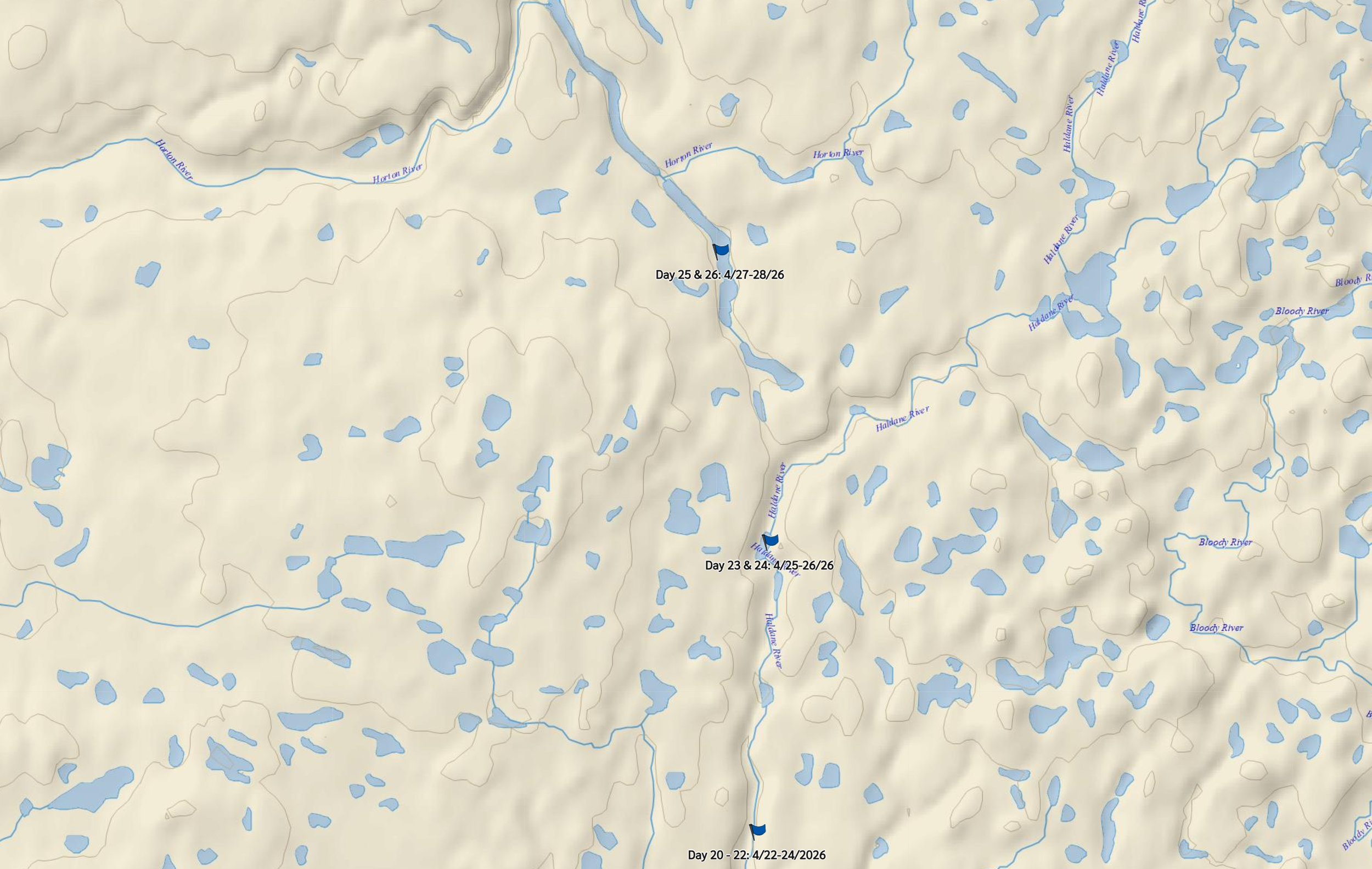
Will completed his relay up to the “headwater lake” as he prepares to cut across the hairpin curve ahead of him on the Horton by going overland. Visit Will’s interactive map for complete control of magnification and orientation.
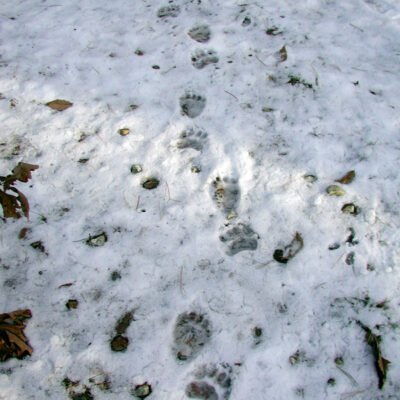
Today’s dispatch indicates what to look for in the days ahead: bear tracks in melting snow. Photo from bear.org.