
Day 23: April 25, 2026
Signs of spring are in the air as a warm up has Will reflecting on the changes that will come with higher temperatures, anticipating migratory birds, thawing drift snow, and 24 hours of daylight.
-
Yeah, Will here. It's March 25th, day 23. Very long day. It's 11 o'clock here. I'm just getting my supper on. Traveled 12 hours, made 14 miles. Been triple loading, though, so three miles straight forward. I think four, four miles straight forward, but I had to do it three times.
But a beautiful day. Warm last night, so I put my head out of the sleeping bag. That was one of the best nights of sleep on the expedition so far. And alto cumulus, which is a sign of warm weather, it got up to about 30 degrees. It's not 32 yet. Strong south wind, indicator of a system coming in. This is probably the beginning of the springtime. And, you know, weather is weather. We could go back to the cold weather, but I don't think this cold weather is going to be around as extensively as it has been. When you get the south winds like this, not quite yet ready for the migrations. But once it comes in solid, it may not be this round of weather yet. But when it comes in in earnest with the south wind, the migration, the birds always follow the south wind up. You can always tell by the weather when you're in this type of weather. I mean, birds have a lot of sense. They don't fight the north wind. They ride the south wind all the time on the migration. They're not quite ready to have any birds coming up yet, but it's the beginning of it. And also, the bears may be coming out of hibernation if this sits around for ... warm weather for another couple days, especially if it intensifies.
I'm very close to the divide here. So, it's just gorgeous topography here. Dave Olesen, my friend, the pilot, described this area as if it looked like a moonscape. And it's the real gentle hills, top of a gentle divide. Everything's all white, beautiful shadows. On the leeward side, there's these huge snow drifts all the time, sometimes 50 feet high, and catches the sunlight. So it was just gorgeous lighting, gorgeous lighting in the evening. And it's hard to photograph this, get a view of it, because it's really low profile. You almost have to be present to appreciate it. And also, I had a little bit of, I wouldn't call it spring fever yet, but it just felt great not to be freezing so much. There was a bit of a wind chill, though, no problem.
And pretty soon now, if this continues, if it gets a little bit warmer, what happens is, you always have blowing snow. It's called drift. And that drift, you know, it causes a lot of problems. You get ... the wind starts blowing over, let's say, 25 miles an hour. All the drift that's on the ground goes into the air. That's why you get some whiteouts. It's ... when it intensifies that's called a ground blizzard wind. A lot of that in Antarctica. We have, you know, lots of snow on the ground when it's not windy. But then it's all in the air. And so a couple of days from now if this continues, that's kind of a landmark when the loose snow freezes up. It just has to be a little bit. And then that's the end of the drift. You can also always get another storm and then you've got that drift going around. But once it thaws a little bit, it eliminates a lot of the, some of the ground blizzards, at least. The last week, eight days, I had two of those where I could see in the distance, but you can't see near, which is typical. Near meaning, you can't see the snow drifts or any type of variation of the land. You know, micro, like a snow drift. If it's a sharp, kind of snow drift, you just plow right into it. And it can be quite annoying if you're doing a long day that way. But so that's ... An all out whiteout is when everything you can't see any more than four feet in front of you. And I've traveled in actual whiteouts. I mean, that's sort of what you do when you're traveling in this country. Although I haven't had many major whiteouts on this expedition yet.
Well, I've got to get my dinner going. I'm getting some drinking water and milk here. I'm on a lake. It's totally level. I've got ice screws in. It's nice to have a level spot. It's only the second time now that I've had ice for drinking. Ice is just absolutely superb. You also save about at least half of the gas when you're melting ice into water versus snow. Snow has a lot of air in it. So, you know, check in. And I usually go to bed here at probably about, you know, 11:30 or so. It's not quite light all the time. But it's getting near that. In another week or so, you'll have light 24 hours. It's really convenient. So, anyways, Will here, over and out.
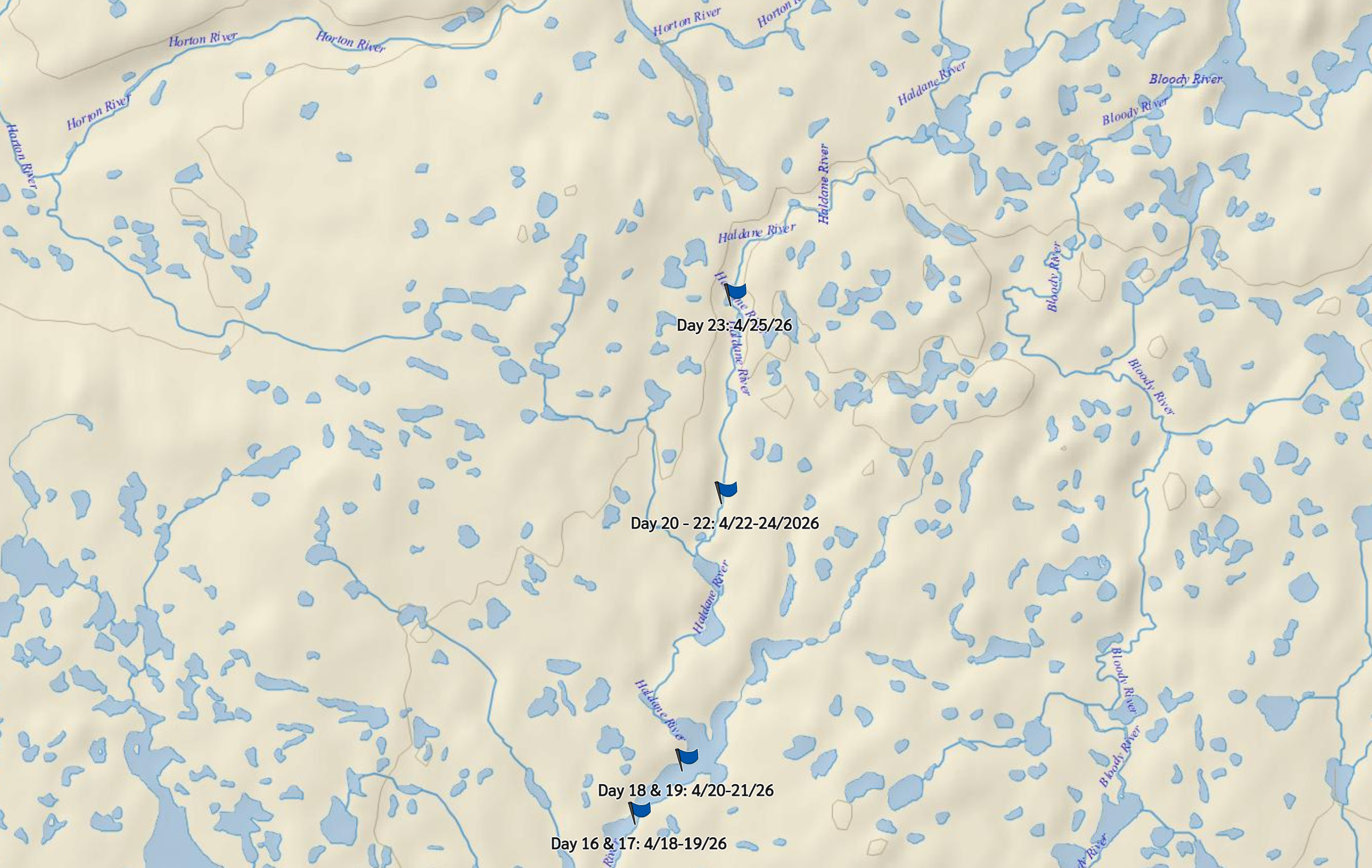
The Horton River, which will be the principle route to the Arctic Ocean, is in view at the top of this map. Visit Will’s interactive map for complete control of magnification and orientation.
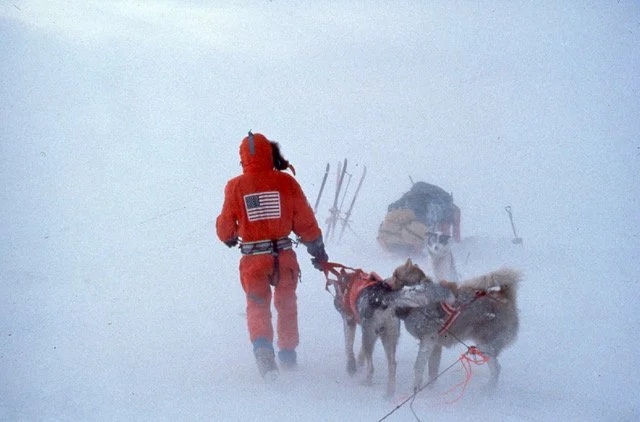
As the weather warms, Will describes how even a little thaw will eliminate “ground blizzard wind” that he has experienced twice on this expedition so far. He recalls experiencing this during his 1989-90 Trans-Antarctica Expedition (seen here), when the winds would stir up the ground cover snow, reducing visibility to a few feet.