
Day 50: May 22, 2026
While waiting out the Horton River breakup, Will begins the story of the Steger Center by dwelling on his own origins, his upbringing, his career path, and his experiences.
-
Yeah, May 22nd, day 49 here on the Horton River. Seventh day here of the wait out. I'm going to start something different today. I'll do a quick news update here on how the day went, and then I'm going to start talking about the Steger Center, and today I will be talking about the origin story, and then each day then I'll pick up on the discussion with the Center, and I'll go into detail on various items.
But today was ... yesterday it rained all day long, and cold, 36 degrees. Today it was cloudy, a little bit of rain, a lot of water, lots of water coming out of the creeks and the streams now from the rain and the melt. Regardless of what the temperature happens here, the river is really starting to rise quite a bit, and the ice is starting to—some of it's breaking up. There's a huge movement of ice jam in front of my camp here today. It's still going to be some time before the entire river breaks up, but it's on its way here, and it's a big difference, especially from yesterday to today. A lot of open water. Probably about 10% of the river is open. That doesn't mean anything because everything is jammed up. And this is my seventh day here, which went really quite fast.
But I want to go into my origin story. Being that this will be like six, seven minutes, if the phone does cut off like it sometimes does, what I'll do is I can tell when it cuts off, and then I'll pick up, I'll pick up on a second call. But my origin story is really I owe everything to my parents, Bill and Margaret Steger. I had the greatest family and parents. We had 10 kids, loving parents. Our parents did one great thing and gave us pretty much total freedom, especially for me. It was very important. And the sense of the freedom I had, I was influenced by how [... ... ...]. And so I ended up taking a motorboat, a 16-foot motorboat down the Mississippi, from Minneapolis to New Orleans and back when I was 15. I recruited my older brother, Tom, who was 17.
But when you just have parents that would give you that freedom to make such a trip—that was my first and last motorized experiences—but through that freedom that I got from my parents, one great thing is I never saw boundaries. If I wanted to do something I had the whereabouts to do it. Most boundaries are mental boundaries of people. You feel usually in your mind giving up that you can't do it and so forth. But I did not have that. I had this sense of adventure, which all kids have, and just incredible curiosity. But because of the parents and the way I was raised, I never lost my sense of adventure and curiosity, which has really made a big difference in my life.
And I've had two influences, both related, in my life. One is wilderness, for sure. Ever since I remember as a child, you know, a real young child, four and five, I wanted to live in the wilderness. You know, I played with Lincoln Logs. And I ... we were six years, we were ... my parents were from Mahtomedi, and then we moved to Richfield in 1952, six years, six years later. But there it was really a wild, wild place as a young kid. And this influence was so great that I ended up buying wilderness land in Ely when I was 19, back in 1964, off-road. This is where my home is today, and that's actually where the Steger Center is. And I ended [.. ... ] when I was 25. And I lived off-road, two lakes to the nearest road, for 25 years. I used dogs for transportation. So the wilderness aspect: I wanted to actually put my young mind into the wilderness. That's really where I wanted to really learn from and place my mind in my 20s and 30s and 40s.
And, of course, the second influence was expeditions. And my influence there was National Geographic. The magazines influenced many of our young people of my generation and younger than me. But it was the pictures that I wrapped my dreams around of these expeditions that I literally never able to take when I was younger or older. I started climbing when I was 16 and did some major climbs from 19 and 20. And it was at this period in my life, through climbing in particular, I really started experiencing the quiet mind of having a mind that was quiet when you're making real calculated moves, rough consequences if you slip, just keeping the mind quiet. And expeditions throughout my life have been my teacher, too. Basically, my expeditions have been a, like a mobile Zen monastery. That's really where I learn. And I learn from my regular life and my life in society as well.
And my expeditions and my life in society are pretty much the same in a way. I mean, an expedition is like a vacation. I leave and then I come back. My whole life is kind of a series of moments like that. And then I'm very fortunate I had a vocation since I was a young child as a teacher and an educator. So I knew what I wanted to do with my life. I wanted to teach. I hated school, the confinement. I was dyslexic. I had a hard time with it. But I liked the social aspects of school. And I liked the recess and the sports that kind of kept me going, I think along with all my other peers. But my vocation didn't come through that formal education. Although the formal education was very important. I got my undergraduate degree in science, geology, biology with a teaching degree certificate. So I taught for three years. And at that time, I got a master's for myself. I wanted to be a formal certified teacher, which I did.
And then in 1970, I had my schooling finally over. I left the city and moved to the wilderness to build a self-sufficient homestead. Where the Center's at right now. I was self-taught in everything. And masteries evolved in carpentry and stonework and that all learned on my own and from other people. Livelihood was very important to me. It's how do you do your service? [... ... ...] And what I did when I moved up is I started a winter school, dog sledding and school, skiing, cross-country skiing. And this was really difficult getting a business going. And it was really a hard thing. But I got it going. And my programs really took off, mainly because of the dogs. No one had ever done dog sledding and skiing like that. So I found myself developing my own programs, j-terms, youth at risk, men's and women's groups, the physical challenge people. Through Wilderness Inquiry, I developed some of their first outdoor winter courses using dogs.
And I was really successful in what I was doing. I could have made a living doing this. But 7-8 years into it, in the late, into the 70s, I start questioning a little bit about my direction in my life. I wasn't reaching the numbers I wanted to in the school. I was very, very comfortable teaching. And I really, I've met 50-60 people a year, became very close. And then I was starting to, at that period, starting to use my dogs in the late spring going up to Hudson Bay doing expeditions. So expeditions started to enter my life. And then I made a big decision in 1982. I gave my business end of the school over to Paul Schurke. And I left the school behind. And I launched my next career, which was going to be in expeditions.
But my real, the real vision I had for myself at that time in the later 70s and 80s, I felt that if I could build a center in the wilderness and influence higher level leaders, that that would be the purpose of my life. I really saw that as that's really what I really wanted to do. I didn't have a roadmap for that at that time. But I did have a vision that where I wanted to go. And at that point, I was launching off on personal long expeditions. And I think our cell time is almost up here. So what I'll do on the next ... sequal! ... I will do a case study of how I got into major expeditions and so forth. And then I think I got a beep here. So I'll tune in tomorrow. Over and out.
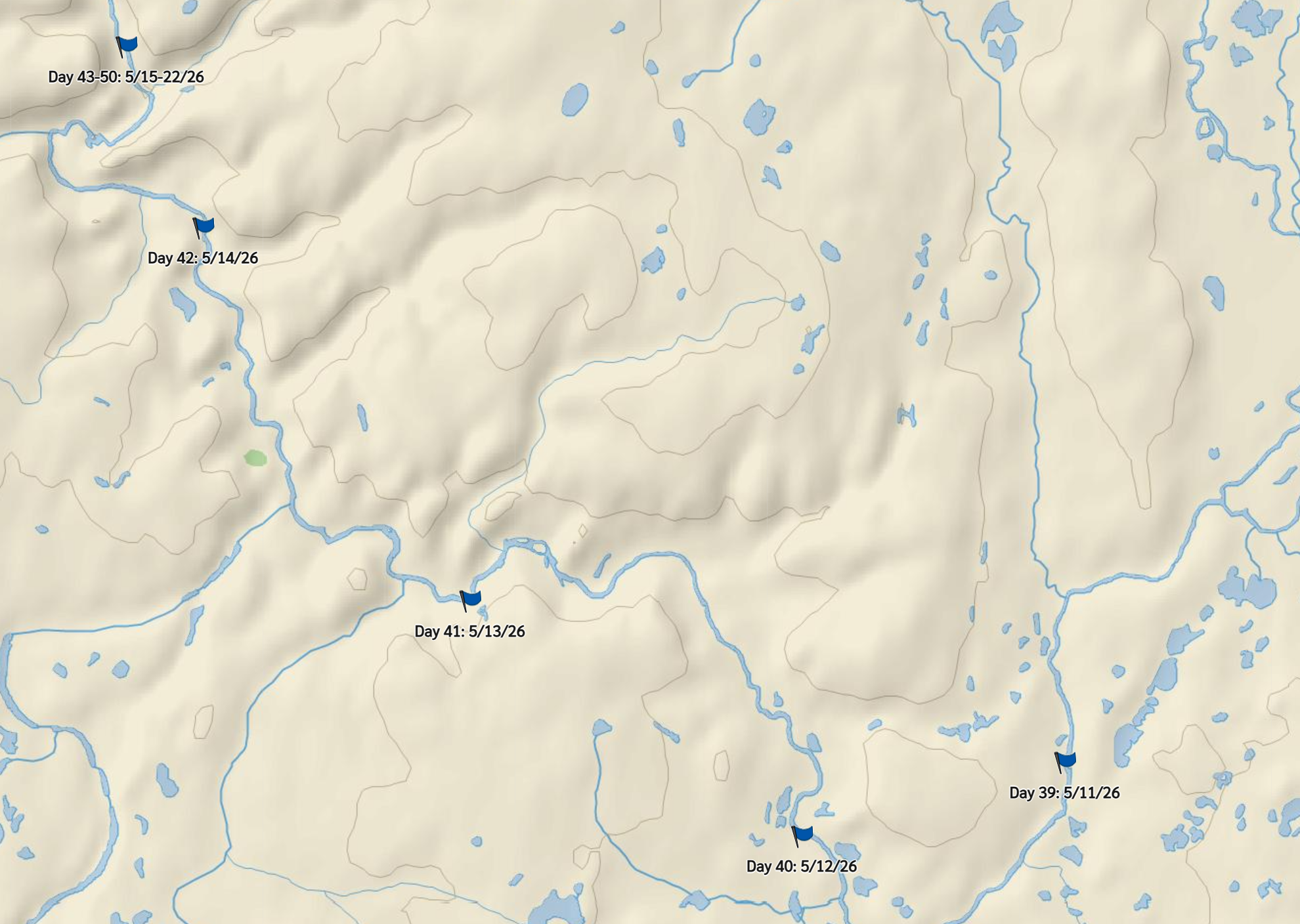
Will’s position is unchanging as the thaw continues and river breakup unfolds on the Horton. Visit Will’s interactive map for complete control of magnification and orientation.
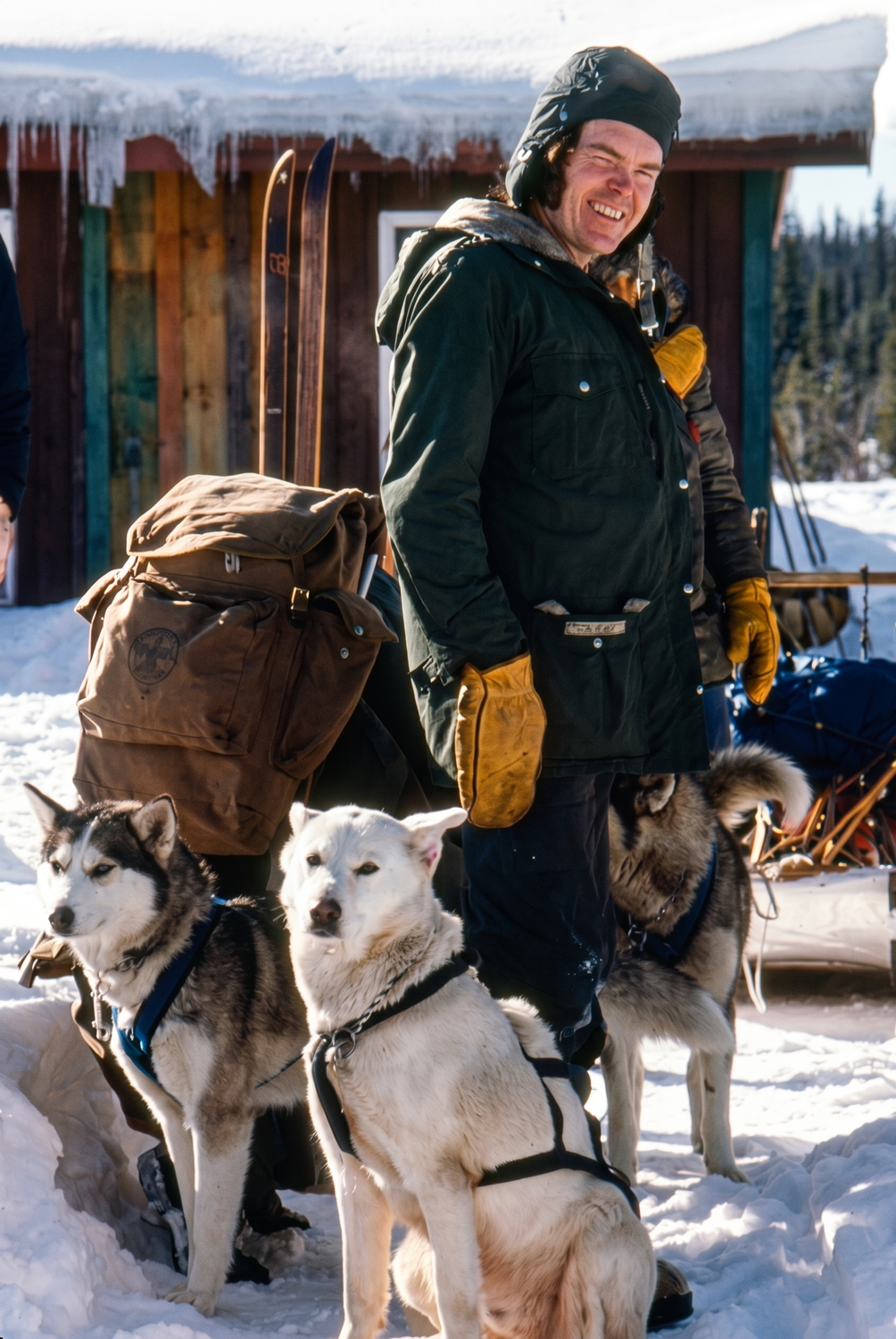
In today’s dispatch, while retracing his path from adventurer to explorer and expeditioner to the Steger Center, Will recalls the challenge of opening a school that focused on the subjects of this photo: skis, sleds, dogs. The school “took off, “mainly because of the dogs.”