
Day 42: May 14, 2026
Continued cold weather keeps the river breakup at bay and yields brittle, “readable” ice that makes for “some of the best river travel I've ever had.“
-
This is Will here, May 14, 2026, day 42 on the Horton River. Really cold this morning again. It was 16 degrees with about 10, 15 mile an hour south wind. And two cold nights in a row, lashing. I thought this was over with in April. You're really ... your hands, your fingers get numb and all that. But I think my fingers have just had it for the season.
It was perfect travel in the morning. It was some of the best river travel I've ever had. All the pools and overflow and the water that was running on the surface three days ago, it's all totally frozen hard now. And when ice is brittle, especially when you have this consistent cold with no warm-up, when it's brittle, it's real perfect to read it. I can read it just like absolutely, 100% actually by the color, by looking at it. There's no nuances or in-between. It's either safe or dangerous. Not all this ice is safe. But like crossing a road, you just don't walk in front of a car. I mean, so there's skills about this. There's some danger, but you just stay out of ... that's areas you stay out of.
But conditions radically changed during the day. And to explain this, I want to explain a little bit about runoff, because runoff is a real big deal in the north. When you ... I'm in the higher topography, the hills, topography is, you know, 400 or 500 feet high, sometimes on either end. You know, it's really pronounced now. And when you have on a high elevation like that ponds and wetlands, and most of this is gravel, and that seeps down like water does, groundwater. It seeps from up above, until hits the low spot, the low spot being the river. And then when it hits the river in the winter, it rolls out and most of it freezes. And then this keeps it ... just because ... The heavy snow also insulates the runoff so that it doesn't freeze. So you have this continual water flowing. And I didn't have that in the headwaters, because that was very meadows and wetlands and pools. There wasn't any height there at all. But now I'm in this, you know, especially the overflow situation.
So all season, you have this ice flowing out and getting thicker and thicker. You know, it gets up to, I've seen it, you know, 10, 20 feet thick. So it just basically floods the whole area. And the runoff is very dangerous in the winter when it's covered with snow, of course. You have to know where it is. And if you go through the snow, that's if you blow into a pool of water. I mean, that's a major, major issue. But in the spring here, now as this water is accumulated, now it's starting to run in a channel. And this channel is sometimes underneath the ice. It forms its own channels. And other times it's flowing out on the surface. And this was happening about three, four days ago. But this cold snap froze everything on the surface, which has really given me this opportunity to travel fast and to get into an area where I can get some firewood and that. So when I wait it out, I've got fuel.
But now it's getting such that these channels are forming in almost a regular stream. And it won't be long here where I—once you get a channel—you can't cross the river. And a lot of times you have to cross from one shore to another in order to avoid pools on these bends. And this is all happening quickly. Today, because of the cold weather the last two days, I was able to bridge all these areas. Normally, three days ago, I just wouldn't, wouldn't even have thought. I mean, you wouldn't go out there. But now it's cold. And I've been able to bridge these channels. But now it's getting so bad. The overflow is ... it's almost across from bank to bank right now. So we'll see what happens. I'm sure tomorrow—almost positive that tomorrow will be my last day on the river.
Today was, it was all under control. I don't take risks. I'm really, really fearful of falling in. So I've got a deep respect for that. But I quit a little early today because it does get on your nerves when you're dealing on thin ice all the time. Even though you know it's safe, it's just you're just totally spot on all the time and reading it. So I have picked out an area where a river comes, another river comes in. And it's about 3.5 miles as raven flies in a straight line. So I'm hoping maybe I can make that. That might be a good place. We'll see what happens, though. It's going to be interesting.
And I think it's going to be cold tonight. And that will give me a reinforced little bit of water that was flowing on the surface. So I think it's going to be perfect to make a dash to see if I can find a spot there where the rivers come in. And it's also where two rivers come in. That's also a really tricky spot. And, you know, I might not even get close to land in that area because of that. I might be able to get upstream side where the river comes in, where the tributaries come in. If I was to take any type of chance whatsoever, I do have a dry suit and a life preserver for me. You know, I used to use a... I mentioned... 10 years I did canoe sled, basically you get a canoe with runners. And that canoe sled is totally designed for this breakup conditions, you know, going in and out in the bad water, out thin ice, back and forth. So that's absolutely safe for these conditions. But having just three sleds, I'm extremely vulnerable. I mean, sleds don't do me any good at all. In fact, if I fell in, they'd probably come in with me if it's thick ice.
But by not taking chances, this is where ... But it's really cool being on a northern river and seeing the whole spring come in and now seeing the breakup. It is a long ways from breaking up. I mean, this is ... I should also add here before I hang up, this overflow and this runoff has nothing to do with the melting temperatures. There's really nothing melting right now except for, I mentioned this brown slush, this water. That's just surface water from swamps and that that are flowing down to the river. That's surface water. It's a very, very small amount of it. It's a big problem when you have it in your way. But the runoff is from this underground water and that's been flowing down all the time. And now that's starting to really make these channels. But we're a long ways from any type of a breakup. I mean, it didn't get above freezing today again and everything's frozen hard. I woke up in the morning and all the pots and pans were frozen. I pre-made my oatmeal and that was in a pot and that was just frozen as a rock. I just get an idea here of the spring. But hopefully we'll see what happens. And tomorrow's going to be an interesting day. But Will here, over and out on day 42, May 14th on the Horton River.
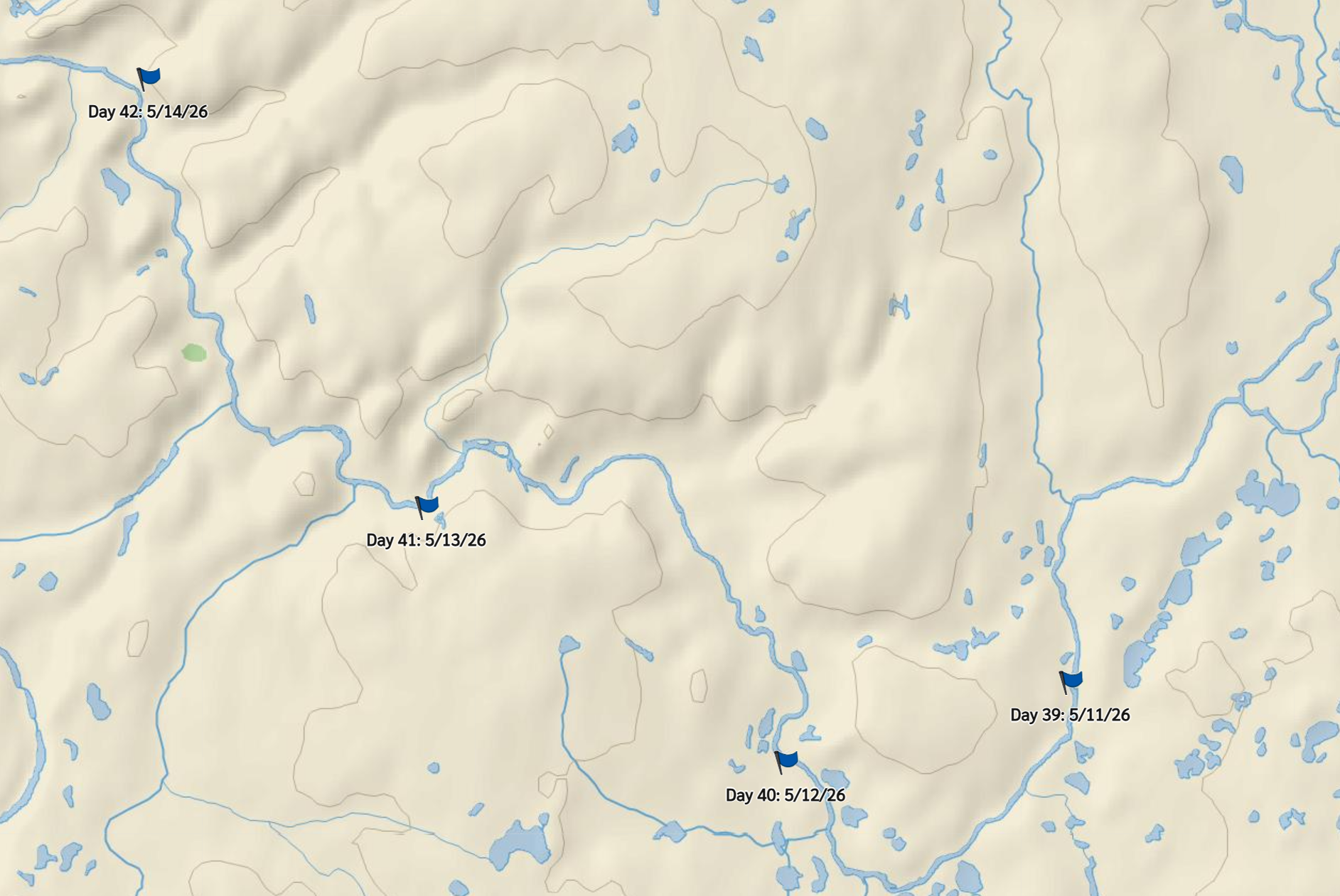
Will has his fourth consecutive day of marking off good mileage as late-spring cold temperatures keep the Horton River traversable. Visit Will’s interactive map for complete control of magnification and orientation.
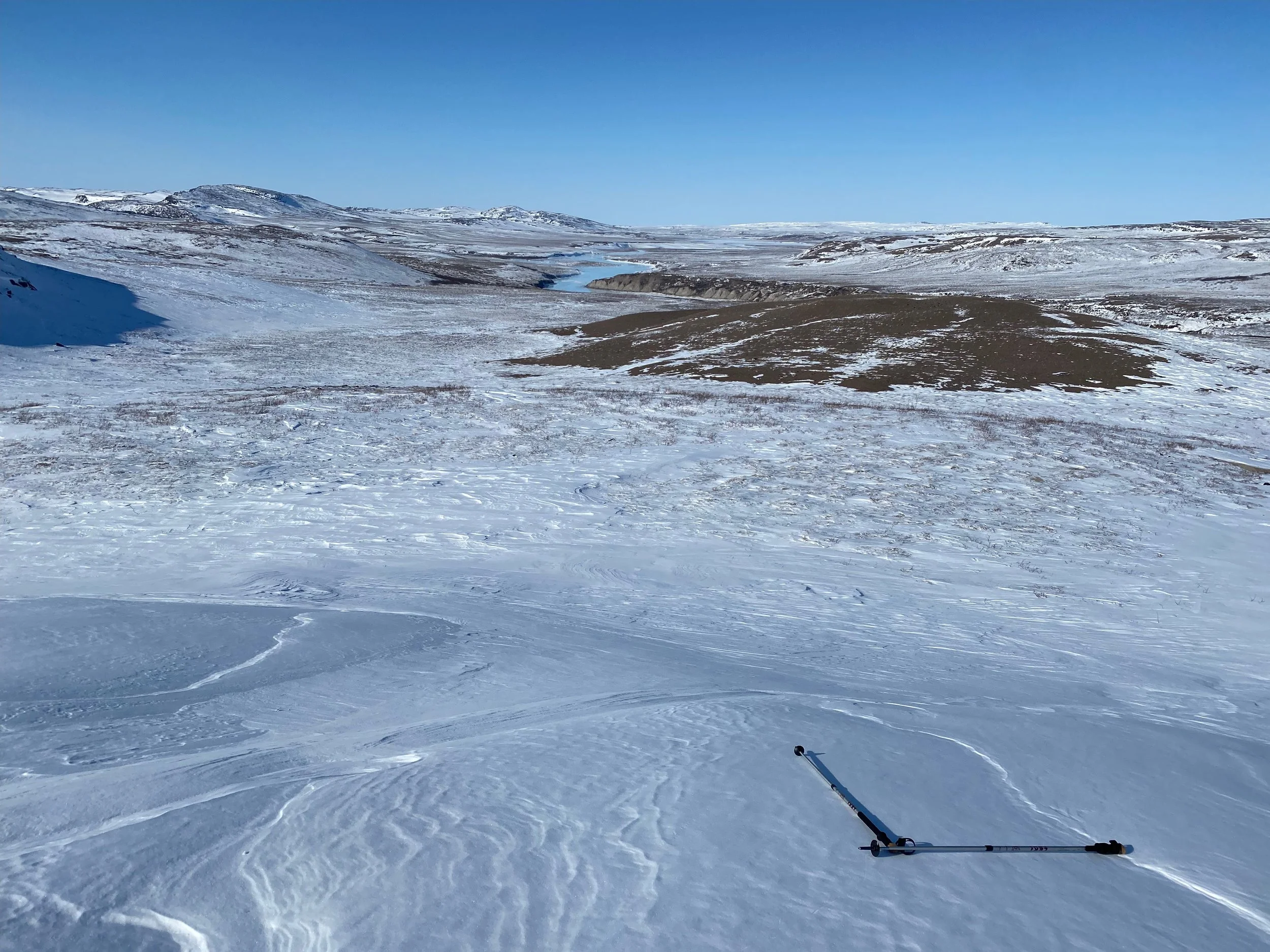
Frozen river in the distance showing the kind of steep riversides that create runoff as Will describes in today’s dispatch. This photo was taken during Will’s 2023 solo expedition.