
Day 29: May 1, 2026
Today Will celebrated the 40th anniversary of the 1986 North Pole expedition by putting in a 12-hour day to finally reach the Horton River, completing 29 days of "knockout, dragged-out hauling" from the Great Bear Lake.
Will’s dispatch includes reflections on effect of the North Pole expedition in his life. Below are two photos taken at the pole at the finish, and a three minute capsule video of the expedition.
-
Yeah, Will here on May 1st, 2026, and day 29. This is an anniversary for me for 40 years of the goal we made it to the North Pole unsupported. And it was a huge event in my life. And it really set me, put me on the map and really helped me develop a career around expeditions and environment and education. And also it was the very beginning of the Seeger Center. And it set the stage for the building of the center. And that direction that I took back 40 years ago enabled me to kind of launch a career in that direction.
And along with Paul Schurke and Ann Bancroft and four others that were with us on the pole, it all made a big difference in our lives. It was a huge, huge historical event, but very very difficult. And one of the hardest things I've ever did, I think, for all of us, all six of us. Paul was my co-leader and Ann—still friends. And that was 40 years ago. I was 41 at that time.
And now here 40 years later today. And I did a long, long day today, pretty close to 12 hours. I finally made that gap from that crossing over to the Horton River itself. And actually, if you want to call it a river here, I'm on the Horton Valley right now. That was really the beginning. It took me 29 days to get this far. And it was a huge, huge effort here, the 29 days. Also, you know, even small injury along the way, like a twisted ankle or a knee or something like that, I would not have been able to make it. But it was really kind of knockout, dragged out, hauling and I made it here. And also a great thing about it is that now the only way out of here is straight north to the Arctic Ocean from here. And this is a totally unknown area here.
The river valley itself is really quite beautiful. It's kind of like a cross between the Serengeti and Mars. It's real, you know, very vast and kind of not rolling so much. But then, it's actually a meadowlands. This is a concern. It's a flat valley and very intimate. And the river itself, where I'm at, it must be about eight feet wide here. It's probably about six feet of snow over it. Who knows? And I'm hoping there's going to be enough water in this thing to get out of here.
But back to the day, today I traveled in whiteout condition, moving my last, I packed up my sled on that lake I've been on for three days and did the final load over. I left, I did two, brought over two of the sleds yesterday. And I [audio break] I was able to pick up the two sleds again. Why I leave a sled or anything like that, I try to do it at a landmark. There's a small little lake where I left it, which is easier to find. But, yeah, there just wasn't anything I could see kind of in the distance. There wasn't any bearings of any sort. It's typical of barren lands. And I couldn't see the snow drifts. There's these sharp snow drifts that kept tipping over the sled. And it was just that I kind of get into the peaceful, quiet mind. And I just kind of went with it all day long, just patient and really there in the present and the nothingness. And, you know, one time the weather did try to break. I saw the blue sky for less than ten minutes. Just a little strip of it. It just gave my spirit, and then went back into the fog again. And I picked up the other load. And then I kind of leapfogged one load at a time. And then went back and picked it up. Well maybe 80 yards.
And finally at the end, there was quite a drop. It surprised me. There was kind of a cross between a ravine and a small little canyon. And it dropped down surprisingly in the fog. I actually saw the ravens do fly sometimes in a whiteout. And down below, there was a whiteout. I didn't even know what I was looking at. It was down there. I saw the raven fly in it. And so I figured it was one of these canyons. These little crags is where our ravens hang out in the weather. But getting down that, I did that in all three loads. You have to be very careful because you can go over a drop real easy. A couple of times I had waterfalls actually on rivers. But you wouldn't expect it in total whiteout conditions. And you just have to be careful all the time. I did scout that first a little bit because I didn't want to go over the edge. Especially with three heavy loads behind me.
But I actually dropped down into the Horton Valley here, which is really serene. And it kind of lifted up for about 15 minutes. I got a good view of it. It would be a very beautiful place. But I think I'm going to try to push a little bit more forward because I probably would need a little bit more water if I can get down the river another ... who knows when this thing will break up. But the meadowlands here is all grassy covered with snow. But if you get one hot day, a sunny day—not that right now, it's 32 today—and one warm day in this whole, it would all be a meadowlands, not green. So you wouldn't be able to travel on it. So this whole silent valley floor will not be travelable as soon as we get a warm day. So I think I'm going to push on. I want to redo my loads and that tomorrow. And I'm real anxious for that.
And so it was a good day. I was really tired coming down. I really felt I'd accomplish something. And it was really good being in that space. It's just like the, I know, where there's nothing, your mind space. You don't have a sense of time. I just, you know, forget about the time element. You just keep plugging away and moving and getting into what you're doing, which is not much. I had a real peaceful mind doing this, which I really, really needed that. [... ... ...] really alone here. And then there was times of just absolute silence where there was no wind blowing. And then the wind couldn't make up its mind. Blew a little east and then to the west and northwest, which is kind of unusual. And kind of keeping me on my toes here, what's it's going to be.
At any rate, making my 10 o'clock upper here. And when I look back at the North Pole. That really helped me on my career. It pPut me on a map where I was able to work on a national level on the environment and education. And I'd never been able to have done that without the North Pole doing that. And I knew that. For me, it was a do-or-die expedition. I simply was not coming back without doing it. And, I mean, that's how I had never had an expedition where I was that [...]. I think the other five members, we had two members, Bob Mantell, Bob McKerrow, who were on injuries, nothing major—frozen toe, frozen feet, and broken ribs. So they weren't functional. They were flown out. The six of us made it. But I think I could speak for everybody. It was a life-changing experience for all of us. It was an all-out. And it opened the doors for me. And I'm very thankful for that on this evening. And thankful, too, to be 40 years later, being out in the unknown again, being on this river. I don't think anyone's ever tried to do this river, you know, from the headwaters like it is now. And there's a lot of unknown ahead. That's a perfect trip. And I'm committed, you know. It's like bridges are burned and the ships are burning at sea. There's no turning back there. It's forward. And so, looking forward to tomorrow. And this is Will on May 1st, over and out.
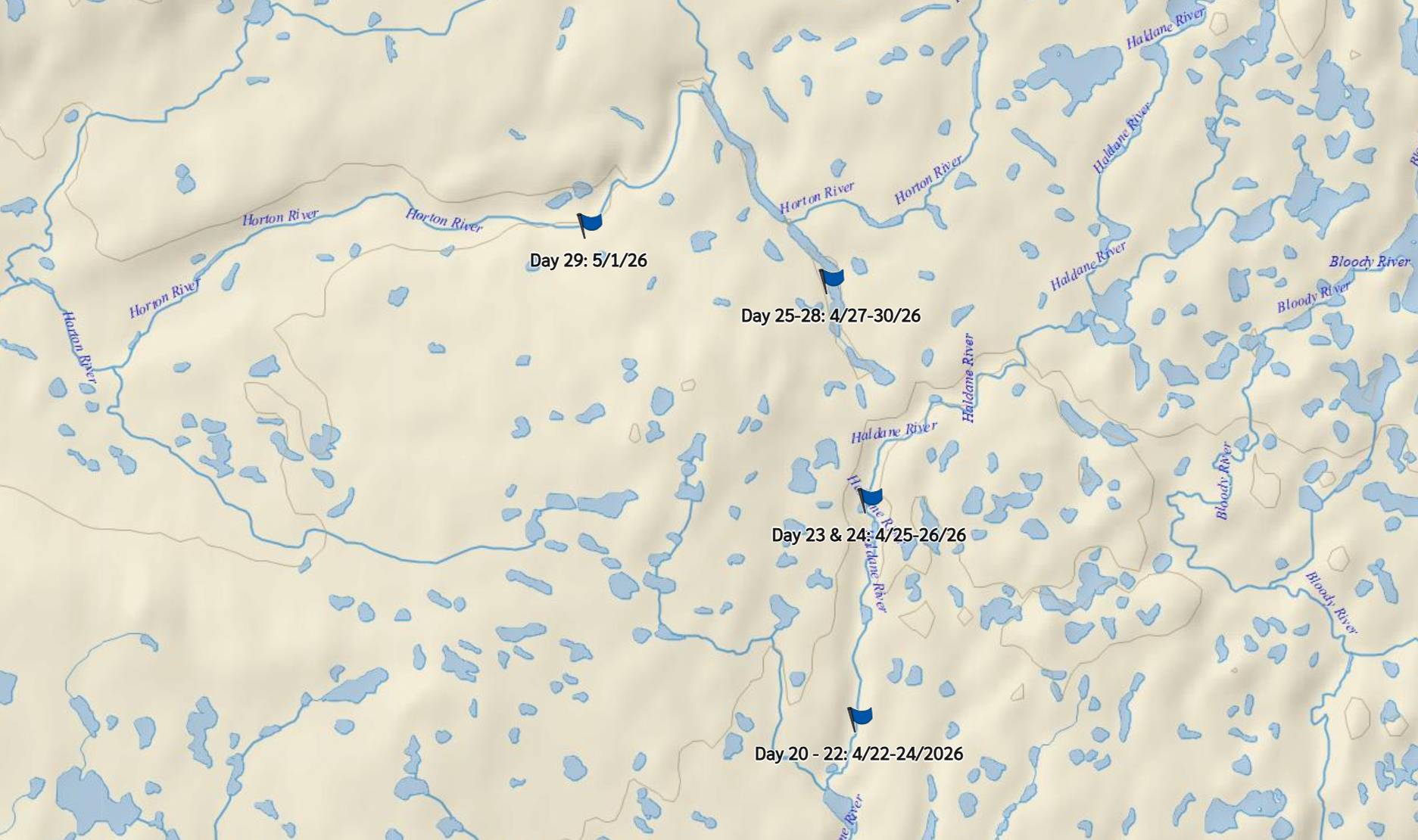
Will’s completed his overland shortcut across the hairpin in the Horton by putting in a 12-hour day in whiteout conditions. Visit Will’s interactive map for complete control of magnification and orientation.
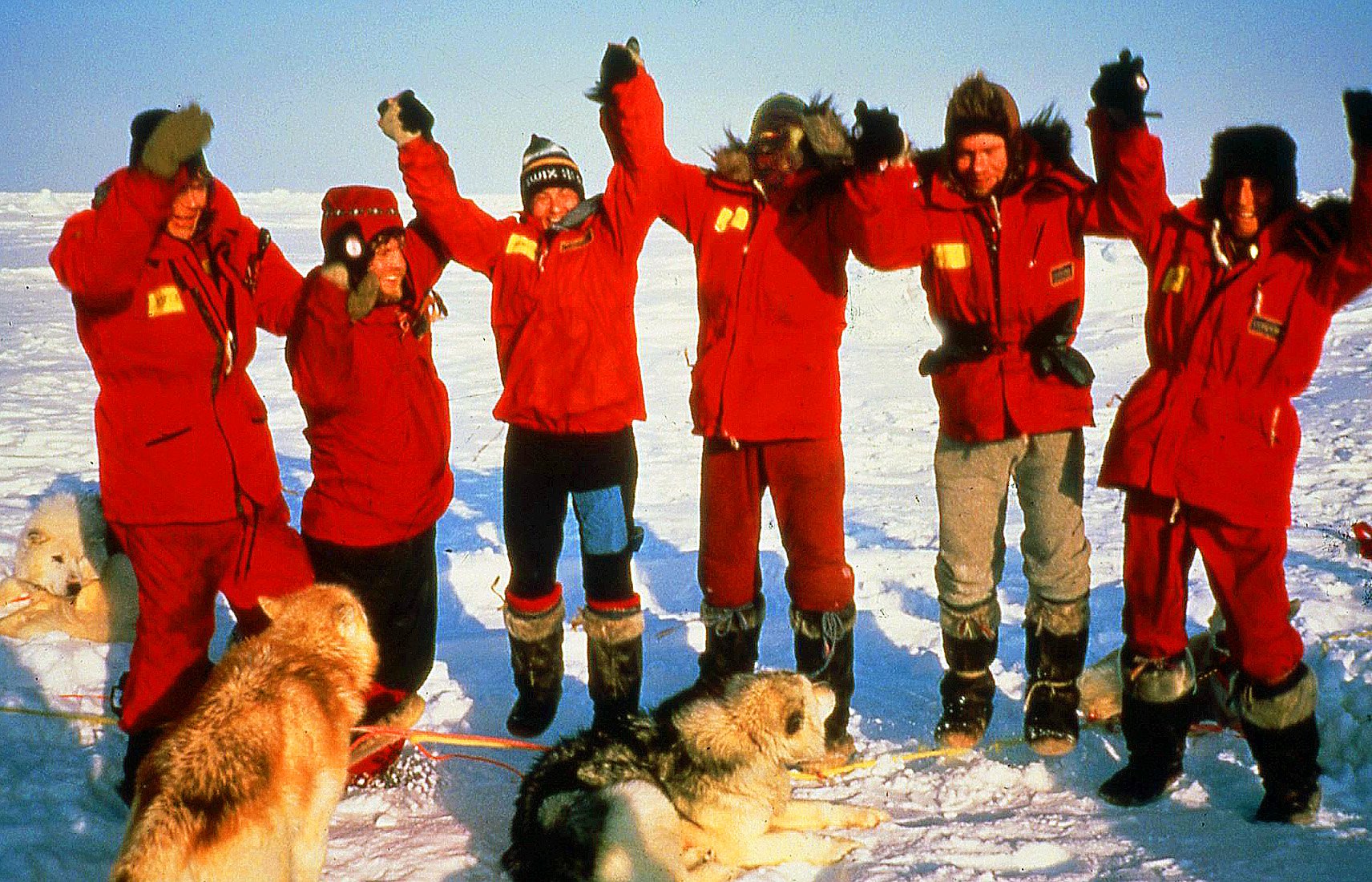
Will Steger, Paul Schurke, Ann Bancroft, Brent Boddy, Geoff Carroll, and Richard Weber jump in celebration in front of bemused dogs.
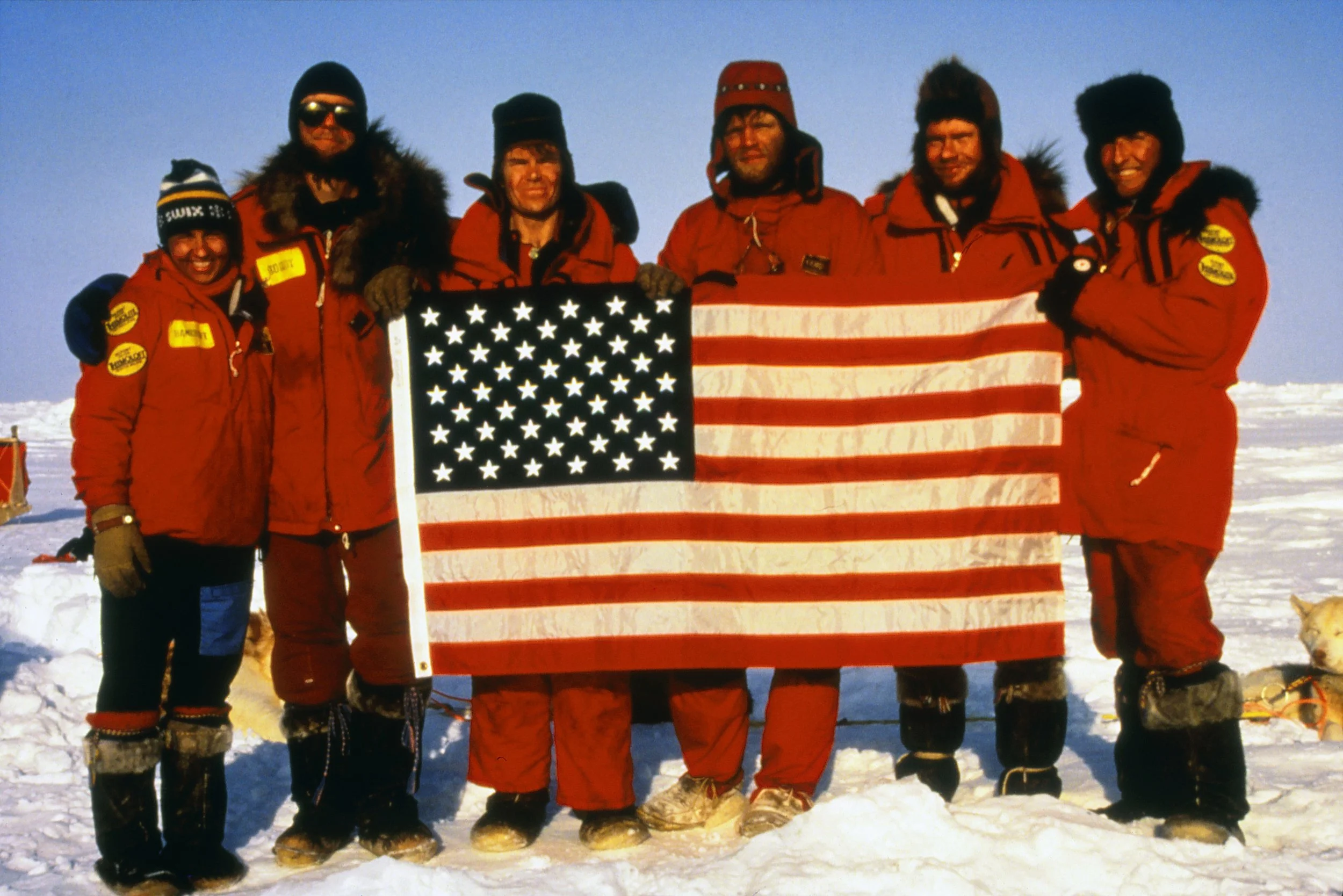
Ann Bancroft, Brent Boddy, Will Steger, Paul Schurke, Geoff Carroll, and Richard Weber.