
Day 11: April 13, 2026
Will has completed his transition from the Bloody to the Haldane River, bridging the gap between them while discovering a colder but faster-traveling world above the tree line. And he finds some company along the way.
-
Yeah, Will here. April 13, 2026, Day 11th. Made two more hauls from the Bloody River there, up the ravine, almost straight up in places. I had a pulley system and kind of a belay perch, kind of a climbing effort, but then I was able to haul two loads then across and then pick up a third load. And basically I got up above the tree line between the two rivers. I'm heading over towards the Haldane, the Haldane River, which heads straight north to the divide where I have the cross.
It's a real severe weather, real cold weather here, clear Northwest wind, which is typical prevailing wind. Windchill is about a ... about 30 (minus 30). The hands freeze up real fast. A totally different climate than the forest. It's an amazing the difference. The big difference though is the hard packed crust. I was able to haul all three sleds for most of the day, once I got up top, a lot more easier. In fact, I was on foot for two or three hours, four hours, walking, hauling, it was a little bit different than on skis. The last 10 days I've been hauling in the deep snow. It's real hard to get traction with your ski poles because your ski poles sink in the snow, sometimes they sink up to your waist so you can't get hardly any traction at all. It's kind of a clumsy type of an exercise. But now, being up on the higher elevation here with the wind and the crust, it's a regular skiing where a lot of my work I do with my hands and shoulders, which relieves the legs to get a more of a natural pace here. I can really dig in when I hit drifts and that.
It's actually quite beautiful. It's really amazing. It's almost like winter here. Winter here is much more brutal. Winter is actually dark. I'm pretty much ... you know, there's only six hours of sort of darkness now. I'm usually sleeping at that time. I'm trying to get into a rhythm where I'm quitting a little later. And that way I can do my chores and that into the darkness and then start off the day a lot later. It's really cold still early in the morning when the sun comes up. So that way I'm in the tent where it's a little more bearable. And I start the day off, you know, around 9:00 or so when there's a little bit of more warmth coming. It's ... I have everything that I have on ... all my clothing I'm now wearing. I'm also wearing that when I'm sleeping now. It's been really tough sleeping because of the cold. I have marginal, you know, I do okay. A lot of my insulation comes from my clothing, winter clothing that I have now (semi-winter clothing). So that kind of fortifies that. But it's really quite tough conditions here. And traveling solo, you have to be very careful. Things can happen real quickly. You're not allowed too many mistakes. The main thing is keep moving and keep yourself warm and getting the systems down.
So, I feel like I've been on the expedition a long time now. You know, don't have any thought at all anymore of home and I'm pretty much in the present moment. It's very, also tough physically. I mean, really getting a good shape now and the fresh air is just amazing. So I'm real inspired. I'm always in the moment. I don't want to miss anything. I don't want to be anywhere or have anything different. I'm pretty much in this beautiful area. But it's quite different though, now with the hard pack. And I'll be gaining another thousand feet of elevation here. And it's going to get colder. Probably spring should be coming soon.
I saw a white— a red fox, actually. He was walking close to me. And I usually do with foxes ... they're a different type of animal. I talked to him, you know, kind of a gentle voice, sang to him. Again, the fox doesn't know the words or anything. But it listens to the vibration. It was kind of fascinating. It came back my way again. It kind of diverted a stretch. And it wasn't in any fear at all. It walked by me, walked away, kept looking back. There was a time once when, in Ely, a bunch of us would get together on Saturday nights there in people's homes and do music, musicians, and that. So I remember on one winter day at Patty Steger' house, we were leaving her house. And we were walking up the hill there. And there was a fox. And I started singing into it. And I told ... there were him a couple of musicians ... and I said "Play it some music. Play music to it." And honest to God, this thing got up on its feet and it danced. Honest to God, I have two witnesses. And we were sober, too. We weren't drinking that evening.
But this fox was quite amazing. He had its full winter's coat. You know, so it's real thick fur. It almost looked like a hot dog with small legs. The fur was over thickness. It had a blackish tail and this gorgeous red thing. But you could tell a wolf track ... a wolf track ... again, it's ... the fox track is smaller than the wolf. And the foxes' have ... their tracks are in a line, straight in a line, that's always a fox.
And so I'm sitting here kind of drying out things, getting ready to put my meal on. And I'll be ... I'm taking ... rather than going down to the Haldane River, I'm going up higher elevation just to stay with this wind and the better surface conditions tomorrow. So I'll check in. And this is Will here April 13, day 11. Over and out.
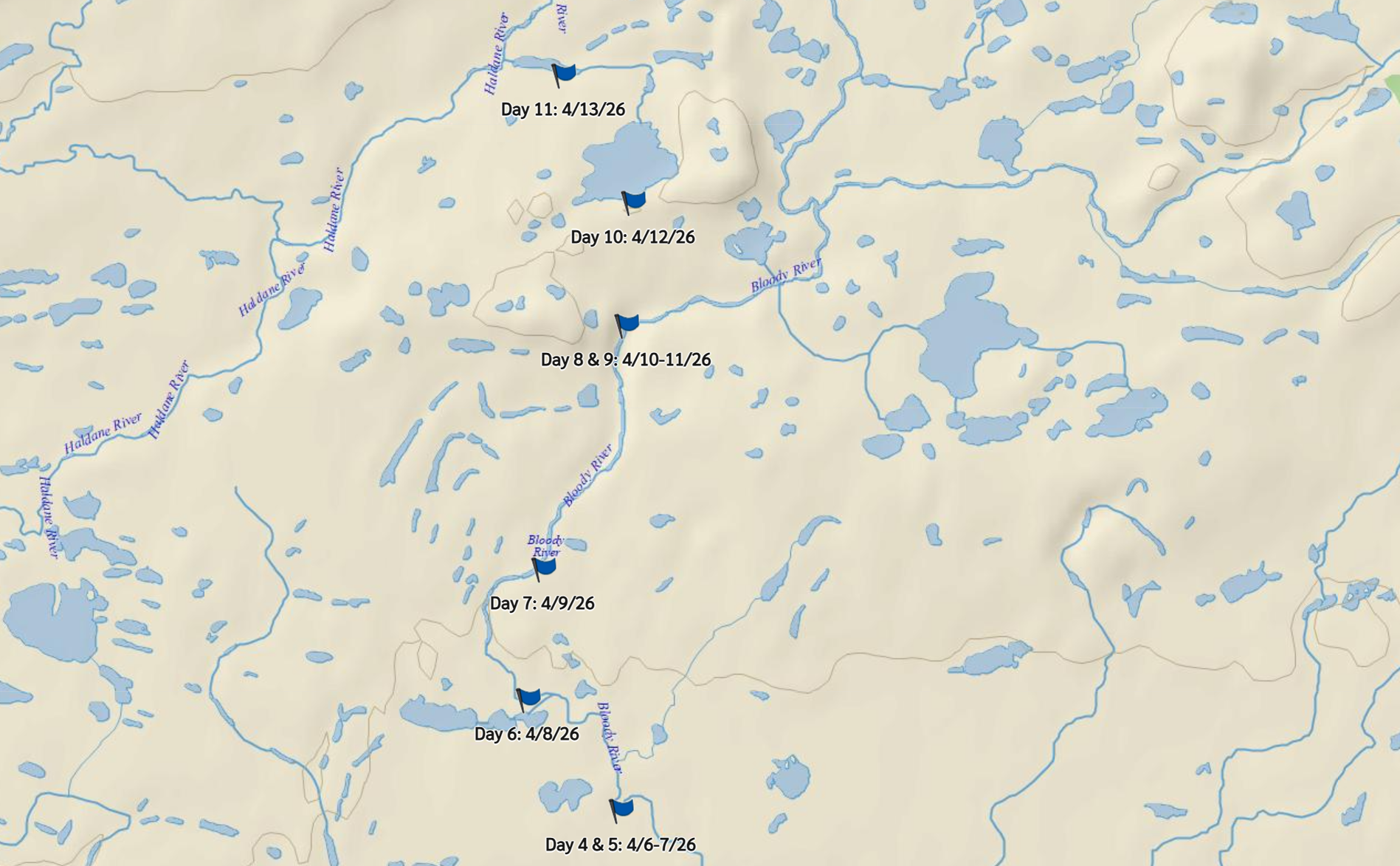
Will’s location at the end of Day 11, reaching the Haldane River. Visit Will’s interactive map for complete control of magnification and orientation.
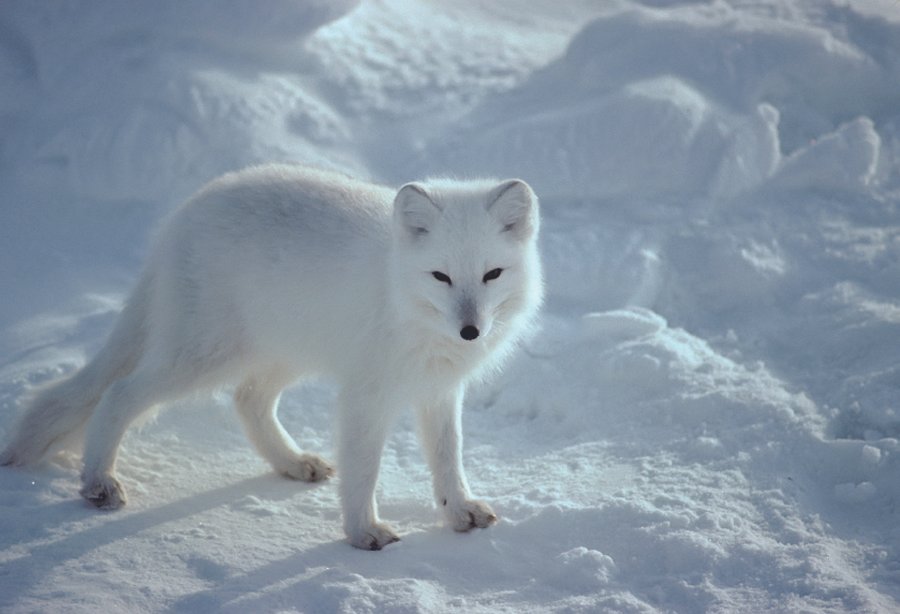
This white Arctic fox (Will describes a red cousin in today’s dispatch) was spotted on a previous expedition.
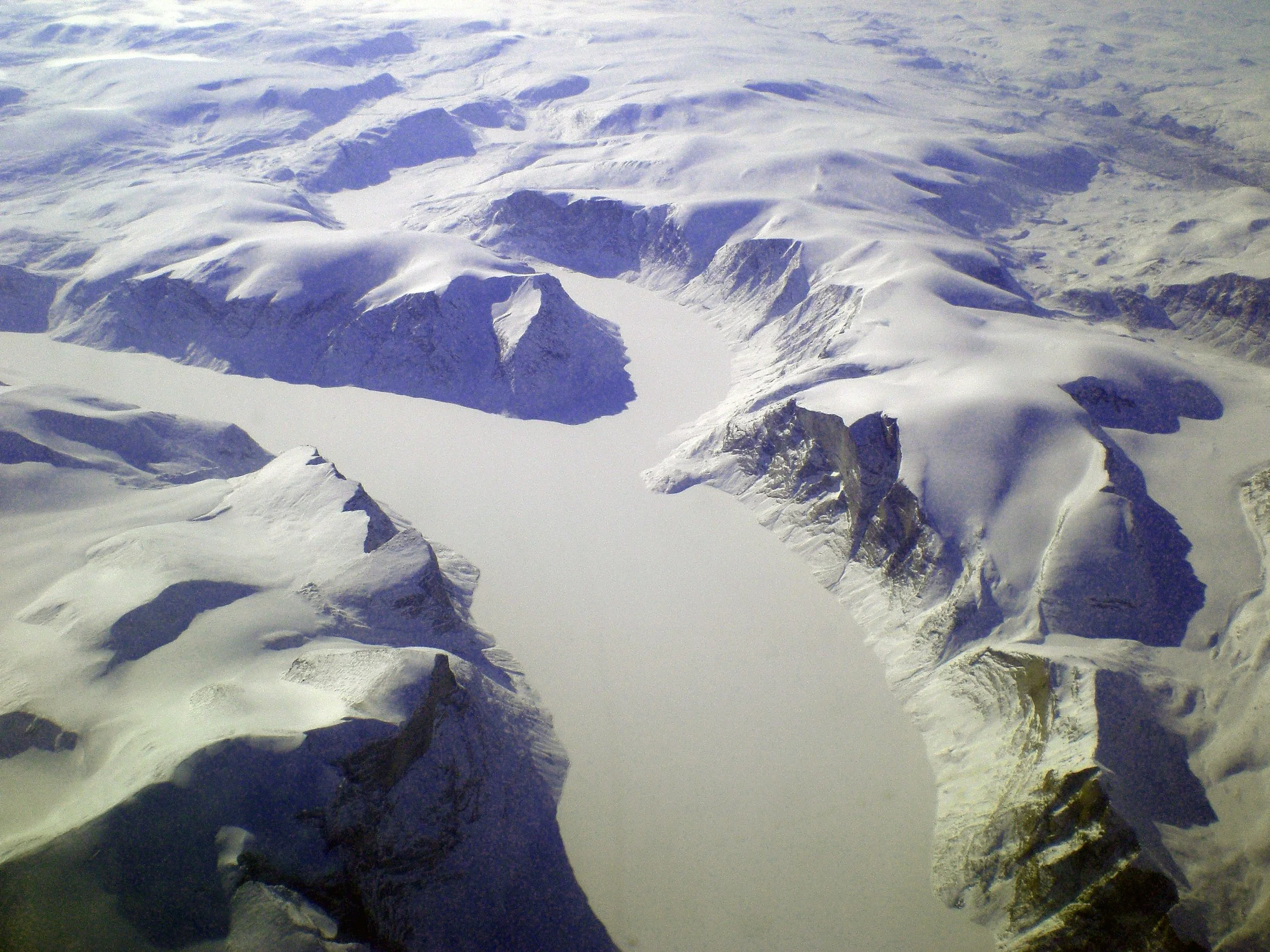
The convergence of two rivers, seen here from a 2007 expedition. Will’s navigation strategy focuses on where rivers lead. His next stretch of travel will follow the Haldane to where it headwaters, which is also where the Horton River headwaters. The Horton will be his principal route to the Arctic Ocean.